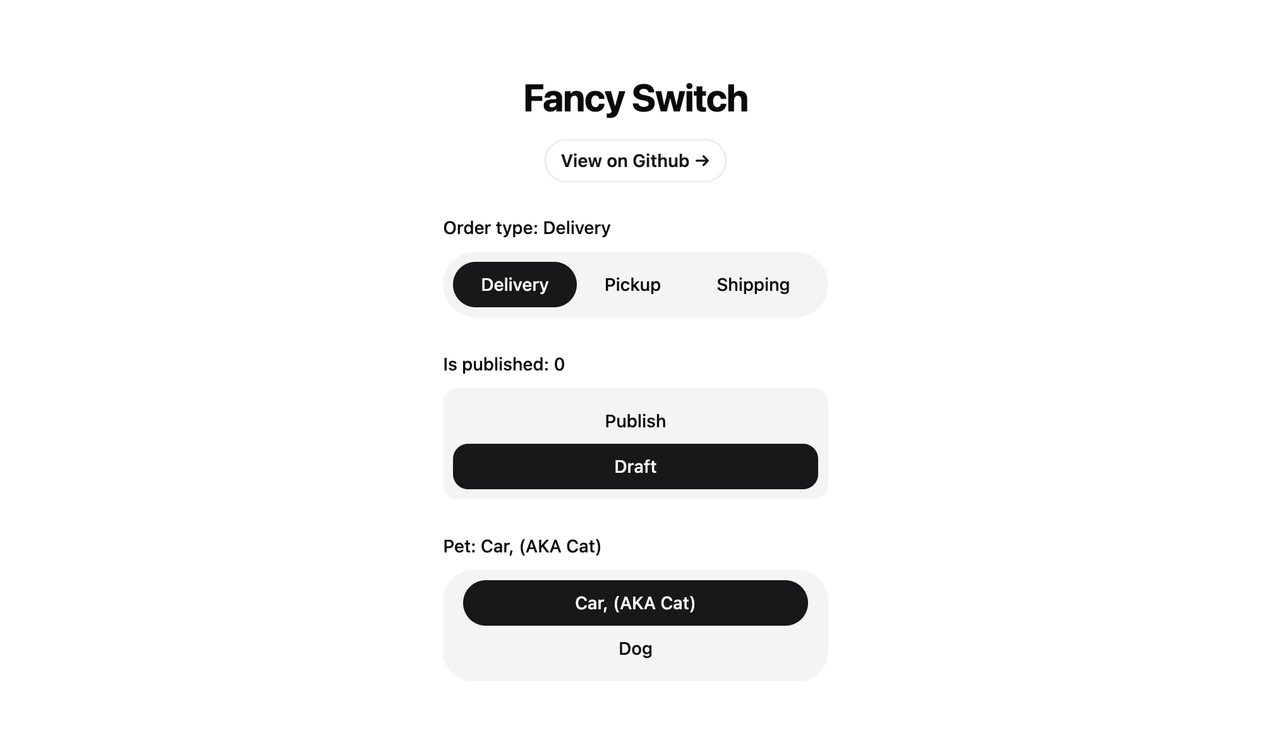




React Fancy Switch is a customizable React component that provides an elegant and interactive way to switch between multiple options. It's designed to be flexible, accessible, and easy to integrate into your React applications, all without requiring framer-motion.
- Supports both primitive (string/number) and object-based options
- Customizable styling for radio buttons and highlighter
- Keyboard navigation support
- Accessible design with proper ARIA attributes
- Smooth transition effects
To use FancySwitch in your project, you can install it via npm:
npm install @omit/react-fancy-switchHere are examples of how to use the FancySwitch component with different types of option arrays:
import React, { useState } from 'react'
import FancySwitch from '@omit/react-fancy-switch'

const StringExample = () => {
  const [selectedOption, setSelectedOption] = useState('apple')

  const options = ['apple', 'banana', 'cherry']

  return (
    <FancySwitch
      options={options}
      value={selectedOption}
      onChange={setSelectedOption}
      className="some-class"
      radioClassName="radio-button"
      highlighterClassName="highlighter"
    />
  )
}import React, { useState } from 'react'
import FancySwitch from '@omit/react-fancy-switch'
const DefaultObjectExample = () => {
const [selectedOption, setSelectedOption] = useState('option1')
const options = [
{ value: 'option1', label: 'Option 1' },
{ value: 'option2', label: 'Option 2' },
{ value: 'option3', label: 'Option 3' }
]
return (
<FancySwitch
options={options}
value={selectedOption}
onChange={setSelectedOption}
radioClassName="radio-button"
highlighterClassName="highlighter"
/>
)
}import React, { useState } from 'react'
import FancySwitch from '@omit/react-fancy-switch'
const CustomObjectExample = () => {
const [selectedOption, setSelectedOption] = useState(1)
const options = [
{ id: 1, name: 'First Choice' },
{ id: 2, name: 'Second Choice' },
{ id: 3, name: 'Third Choice' }
]
return (
<FancySwitch
options={options}
value={selectedOption}
onChange={setSelectedOption}
valueKey="id"
labelKey="name"
radioClassName="radio-button"
highlighterClassName="highlighter"
/>
)
}| Prop | Type | Default | Description |
|---|---|---|---|
options |
OptionType[] |
Required | An array of options to display. Can be primitives or objects. |
value |
OptionValue |
- | The currently selected value. |
onChange |
(value: OptionValue) => void |
- | Callback function called when the selection changes. |
valueKey |
string |
'value' |
The key to use for the option's value when using object options. |
labelKey |
string |
'label' |
The key to use for the option's label when using object options. |
disabledKey |
string |
'disabled' |
The key to use for the option's disabled state (object options). |
radioClassName |
string |
- | CSS class name for the radio button elements. |
highlighterClassName |
string |
- | CSS class name for the highlighter element. |
highlighterIncludeMargin |
boolean |
false |
Whether to include margins in highlighter size calculations. |
highlighterStyle |
React.CSSProperties |
- | Custom styles for the highlighter element. |
disabledOptions |
OptionValue[] |
[] |
An array of values for options that should be disabled. |
Additional HTML attributes for the container div can be passed as props and will be spread onto the root element.
type OptionValue = string | number | boolean
interface OptionObject {
  [key: string]: OptionValue
}
type OptionType = OptionValue | OptionObjectThe FancySwitch component provides several ways to customize its appearance:
- Use the
classNameprop to style the container div. - Use the
radioClassNameprop to style individual radio buttons. - Use the
highlighterClassNameprop to style the highlighter element. - Use the
highlighterStyleprop to apply custom inline styles to the highlighter.
Example:
<FancySwitch
  className="flex rounded-full bg-muted p-2"
  highlighterClassName="bg-primary rounded-full"
  radioClassName="relative mx-2 flex h-9 cursor-pointer items-center justify-center rounded-full px-3.5 text-sm font-medium transition-colors focus:outline-none data-[checked]:text-primary-foreground"
  highlighterIncludeMargin={true}
  highlighterStyle={{ backgroundColor: 'blue', borderRadius: '8px' }}
/>FancySwitch is built with accessibility in mind:
- It uses proper ARIA attributes for screen readers.
- Keyboard navigation is supported (arrow keys to move between options).
- Focus management is handled automatically.
- There's a visually hidden live region that announces the selected option.
You can disable specific options using the disabledOptions prop:
<FancySwitch
  options={options}
  value={selectedOption}
  onChange={setSelectedOption}
  disabledOptions={['option2']}
/>FancySwitch is written in TypeScript and provides type definitions. The component is generic, allowing you to specify the type of your options:
import FancySwitch from '@omit/react-fancy-switch'

type MyOptionType = {
  id: number
  name: string
  isDisabled: boolean
}

const options: MyOptionType[] = [
  { id: 1, name: 'Option 1', isDisabled: false },
  { id: 2, name: 'Option 2', isDisabled: true },
  { id: 3, name: 'Option 3', isDisabled: false }
]

;<FancySwitch<MyOptionType>
  options={options}
  valueKey="id"
  labelKey="name"
  disabledKey="isDisabled"
  value={selectedOption}
  onChange={setSelectedOption}
/>
This ensures type safety when working with custom option types.
This project is open source and available under the MIT License.