
An extensible application for penetration testers and software developers to decode/encode data into various formats.
Decoder++ can be either installed by using pip.
# Install using pip (latest:qt6)
pip3 install decoder-plus-plus[qt6]

# Install using pip (backport:qt5)
pip3 install decoder-plus-plus[qt5]
Please refer to the Installation Guide for more information regarding individual setups.
This section provides you with an overview about the individual ways of interacting with Decoder++. For additional
usage information check out the Advanced Usage section.
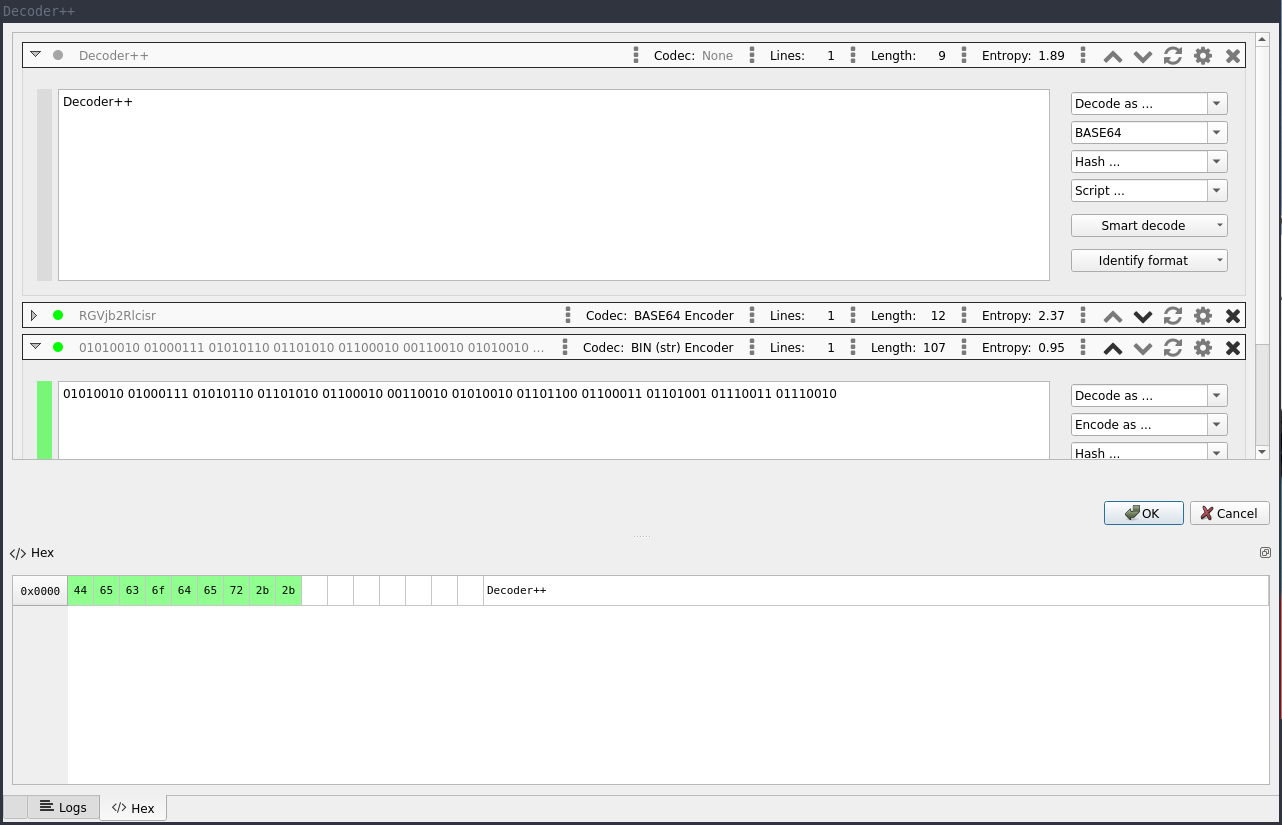
If you prefer a graphical user interface to transform your data
Decoder++ gives you two choices: a main-window-mode and a dialog-mode.

While the main-window-mode supports tabbing, the dialog-mode has the ability to return the transformed content to stdout
ready for further processing. This comes quite in handy if you want to call Decoder++ from other tools
like BurpSuite (check out the BurpSuite Send-to extension) or any other script
in which you want to add a graphical user interface for flexible transformation of any input.
If you don't want to startup a graphical user interface but still make use of the various transformation methods of
Decoder++ you
can use the commandline mode:
$ dpp -e base64 -h sha1 "Hello, world!"
e52d74c6d046c390345ae4343406b99587f2af0d- User Interfaces:
- Graphical User Interface
- Command Line Interface
- Preinstalled Scripts and Codecs:
- Encode/Decode: Base16, Base32, Base45, Base64, Base64 (URL-safe), Binary, Gzip, Hex, Html, JWT, HTTP64, Octal, Url, Url+, Zlib
- Hashing: Adler-32, Apache-Md5, CRC32, FreeBSD-NT, Keccak224, Keccak256, Keccak384, Keccak512, LM, Md2, Md4, Md5, NT, PHPass, RipeMd160, Sha1, Sha3 224, Sha3 256, Sha3 384, Sha3 512, Sha224, Sha256, Sha348, Sha512, Sun Md5
- Scripts: CSS-Minify, Caesar, Extract URLs, Filter-Lines, Identify File Format, Identify Hash Format, JS-Beautifier, JS-to-XML, JQ, JSONPath, HTML-Beautifier, Little/Big-Endian Transform, Reformat Text, Remove Newlines, Remove Whitespaces, Search and Replace, Split and Rejoin, Unescape/Escape String, XPath
- Format-Identification
- Smart-Decode
- Plugin System
- Load & Save Current Session
- Supported Platforms:
- Windows
- Linux
- MAC
This section provides you with additional information about how the command line interface can be used.
The commandline interface gives you easy access to all available codecs.
To list them you can use the -l argument. To narrow down your search the -l
argument accepts additional parameters which are used as filter:
$ dpp -l base enc

Codec                 Type
-----                 ----
base16                encoder
base32                encoder
base64                encoder
Decoder++ distinguishes between encoders, decoders, hashers and scripts.
Like the graphical user interface the command line interface allows you to use multiple codecs in a row:
$ dpp "H4sIAAXmeVsC//NIzcnJ11Eozy/KSVEEAObG5usNAAAA" -d base64 -d gzip
Hello, world!
While encoders, decoders and hashers can be used right away, some of the scripts may require additional configuration.
To show all available options of a specific script you can add the help parameter:
$ dpp "Hello, world!" -s split_and_rejoin help

Split & Rejoin
==============

             Name  Value  Group            Required  Description
             ----  -----  -----            --------  -----------
   split_by_chars         split_behaviour  yes       the chars used at which to split the text
  split_by_length  0      split_behaviour  yes       the length used at which to split the text
rejoin_with_chars                          yes       the chars used to join the splitted text
To configure a specific script you need to supply the individual options as name-value pairs (e.g. search_term="Hello"):
$ dpp "Hello, world!" -s search_and_replace search_term="Hello" replace_term="Hey"
Hey, world!
Feel free to open a new ticket for feature requests or bugs. Also don't hesitate to issue a pull-request for new features/plugins. Check out the Development Guide in order to see how Decoder++ is structured and how easy new features can be added.
Thanks to
- Tim Menapace (RIPEMD160, KECCAK256)
- Robin Krumnow (ROT13)
When starting Decoder++ in Mac OS signals are not working.
This might happen when PyQt6 is installed using homebrew.
When starting Decoder++ in CygWin an error occurs:
ModuleNotFoundError: No module named 'PyQt6'
This might happen even if PyQt6 is installed using pip.
Currently there is no fix for that. Instead it is recommended
to start Decoder++ using the Windows command line.
When starting Decoder++ the error No module named 'PyQt6.sig' is displayed on the console.
This may happen when there are competing versions of PyQt6 installed. Reinstalling PyQt6 should fix this error.
$ sudo pip3 uninstall PyQt6
$ sudo pip3 install PyQt6
At least in Ubuntu 22.04 it might be necessary to install the following packages using apt:
apt install libqt6core6 libqt6network6 libqt6openglwidgets6 libqt6widgets6
In order to run dpp inside a container/virtual machine you may need to install the
qt6-qpa-plugins inside the container/virtual machine and configure the
QT_QPA_PLATFORM_PLUGIN_PATH accordingly:
apt install qt6-qpa-plugins
export QT_QPA_PLATFORM_PLUGIN_PATH=/usr/lib/x86_64-linux-gnu/qt6/plugins/platforms/
See the Docker build and run scripts for more information regarding how to build and run a Decoder++ Docker container.
- PortSwigger's Burp Decoder
- QtPy / PyQt5 / PyQt6
- QtAwesome