
This Getting Started with Elastic Stack example provides sample files to ingest, analyze & visualize NGINX access logs using the Elastic Stack. This example uses JSON formatted version of Nginx logs. The NGINX log format entry used to generate these logs is shown in Download section below.
This example historically used Logstash for ingestion. Per recommended best practices this is now achieved with Filebeat. The Logstash configuration is provided for reference only.
By default NGINX uses \xXX to encode some characters. The resulting "JSON" string is not valid (the JSON standard specifies \u00XX) and in Logstash you will get a json parse error for the invalid JSON string. It only happens when any variables e.g. $http_user_agent contain characters that NGINX will escape e.g. backslash or reverse solidus.
Newer versions of NGINX (>=1.11.8) support escape=json as an argument to log_format. See the ngx_http_log_module documentation.
Example has been tested in following versions:
- Elasticsearch 6.0
- Elasticsearch user agent plugin 6.0
- Elasticsearch user geoip plugin 6.0
- Filebeat 6.0
- Kibana 6.0
- nginx_json_logs - Sample JSON Nginx log files
- ngix_json_filebeat.yml - Filebeat configuration for ingesting JSON files.
- nginx_json_kibana.json - Custom Kibana dashboard.
- nginx_json_template.json - ES Template for ingestion.
- nginx_json_pipeline.json - ES Pipeline for ingestion.
- nginx_json_logstash.conf - Logstash configuration. REFERENCE ONLY.
-
Follow the Installation & Setup Guide to install and test the Elastic Stack stack (you can skip this step if you have a working installation of the Elastic Stack,)
-
Run Elasticsearch & Kibana
<path_to_elasticsearch_root_dir>/bin/elasticsearch <path_to_kibana_root_dir>/bin/kibana -
Install the required plugins
  <path_to_elasticsearch_root_dir>/bin/elasticsearch-plugin install ingest-user-agent
  <path_to_elasticsearch_root_dir>/bin/elasticsearch-plugin install ingest-geoip
-
Check that Elasticsearch and Kibana are up and running.
- Open
localhost:9200in web browser -- should return status code 200 - Open
localhost:5601in web browser -- should display Kibana UI.
Note: By default, Elasticsearch runs on port 9200, and Kibana run on ports 5601. If you changed the default ports during/after installation, change the above calls to use appropriate ports.
- Open
-
Download and install Filebeat as described here. Do not start Filebeat
Download the following files in this repo to a local directory:
nginx_json_logs- sample JSON formatted NGINX logs**nginx_json_filebeat.yml- Filebeat configurationnginx_json_template.json- ES templatenginx_json_kibana.json- Kibana dashboardsnginx_json_pipeline.json- Ingestion pipeline
Unfortunately, Github does not provide a convenient one-click option to download entire contents of a subfolder in a repo. Use sample code provided below to download the required files to a local directory:
wget https://raw.githubusercontent.com/elastic/examples/master/Common%20Data%20Formats/nginx_json_logs/nginx_json_logs
wget https://raw.githubusercontent.com/elastic/examples/master/Common%20Data%20Formats/nginx_json_logs/nginx_json_filebeat.yml
wget https://raw.githubusercontent.com/elastic/examples/master/Common%20Data%20Formats/nginx_json_logs/nginx_json_kibana.json
wget https://raw.githubusercontent.com/elastic/examples/master/Common%20Data%20Formats/nginx_json_logs/nginx_json_template.json
wget https://raw.githubusercontent.com/elastic/examples/master/Common%20Data%20Formats/nginx_json_logs/nginx_json_pipeline.json
** The JSON formatted NGINX logs used in this example were created with the following log_format entry in the nginx.config file.
log_format json_logstash '{ "time": "$time_local", '
                           '"remote_ip": "$remote_addr", '
                           '"remote_user": "$remote_user", '
                           '"request": "$request", '
                           '"response": "$status", '
                           '"bytes": "$body_bytes_sent", '
                           '"referrer": "$http_referer", '
                           '"agent": "$http_user_agent" }';
-
Move the file
nginx_json_filebeat.ymlto the Filebeat installation directory i.e.mv nginx_json_filebeat.yml <filebeat_installation_dir>/nginx_json_filebeat.yml
-
Install the ingest pipeline
curl -XPUT -H 'Content-Type: application/json' 'localhost:9200/_ingest/pipeline/nginx_json_pipeline' -d @nginx_json_pipeline.json
-
Install the Elasticsearch template
curl -XPUT -H 'Content-Type: application/json' 'localhost:9200/_template/nginx_json' -d @nginx_json_template.json
-
Start Filebeat to begin ingesting data to Elasticsearch, modifying the command below to point to your Elasticsearch instance and the sample log file
nginx_json_logs. Ingestion should take around a few seconds. Ingestion should take around a min.cd <filebeat_installation_dir> ./filebeat -e -c nginx_json_filebeat.yml -E "output.elasticsearch.hosts=["localhost:9200"]" -E "filebeat.prospectors.0.paths=["<path to nginx_json_logs>"]"
-
Verify that data is successfully indexed into Elasticsearch.
Running
http://localhost:9200/nginx_json_elastic/_countshould return a response a"count":51462
- Access Kibana by going to
http://localhost:5601in a web browser - Connect Kibana to the
nginx_json_elasticindex in Elasticsearch (auto-created in step 1)- Click the Management tab >> Index Patterns tab >> Add New. Specify
nginx_json_elasticas the index pattern name, selecting @timestamp as the time field, and click Create to define the index pattern. - If this is the only index pattern declared, you will also need to select the star in the top upper right to ensure a default is defined.
- Click the Management tab >> Index Patterns tab >> Add New. Specify
- Load sample dashboard into Kibana
- Click the Management tab >> Saved Objects tab >> Import, and select
nginx_json_kibana.json - On import you will be asked to overwrite existing objects - select "Yes, overwrite all". Additionally, select the index pattern "nginx_json_elastic" when asked to specify a index pattern for the dashboards.
- Click the Management tab >> Saved Objects tab >> Import, and select
- Open dashboard
- Click on Dashboard tab and open
Sample Dashboard for Nginx Logsdashboard
- Click on Dashboard tab and open
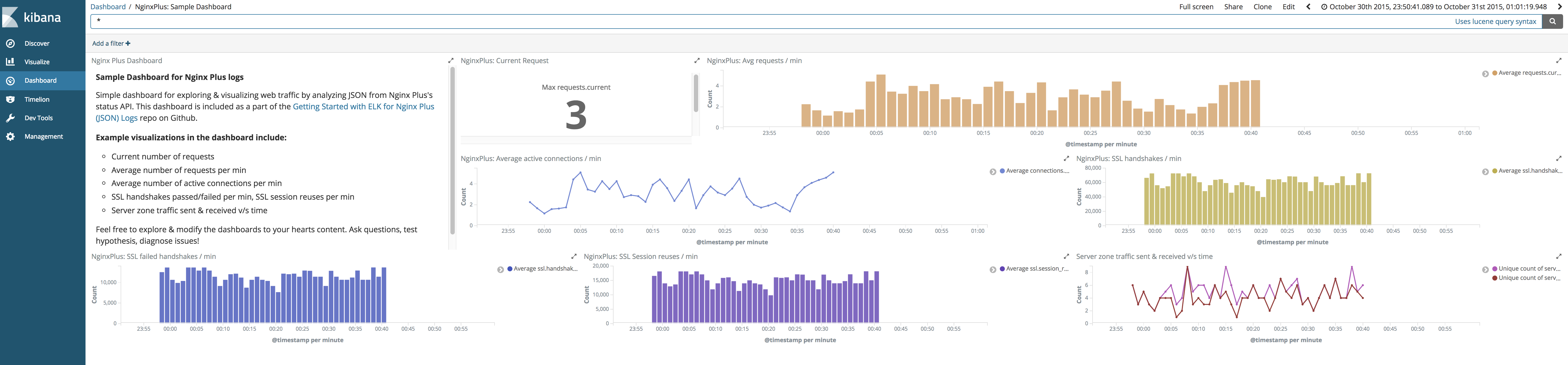
Voila! You should see the following dashboards. Enjoy!
If you found this example helpful and would like to see more such Getting Started examples for other standard formats, we would love would to hear from you. If you would like to contribute examples to this repo, we'd love that too!