---
title: Applied Data Science - Lessons Learned for the Data-Driven Business
layout: page
comments: false
---
### Braschler, Stadelmann, Stockinger (Eds.)
**Springer, 2019**
Companion website to the book [*Applied Data Science - Lessons Learned for the Data-Driven Business*](https://www.springer.com/us/book/9783030118204).
[ ](http://stdm.github.io/images/apd-cover.jpg)
## Synopsis
While Data Science is somewhat a “hype topic” these days, and numerous books on the topic have been published recently, there is little literature that actually addresses the applied side of Data Science - which is, as we argue, where discussion of Data Science should actually start: as a discipline that blends and merges a diverse set of well-established research fields, Data Science is all about finding the right synergy to build exciting (and efficient) data products for projects both in academia and industry.
This volume highlights Data Science as something that is real, where technology is deployed in data-intensive projects, experiences are collected and lessons are learned. The book is clearly positioned as complementary to textbooks that cover the theoretical fundamentals of Data Science. While we start the book by including a “big picture” overview of the field Data Science, this overview is not intended to compete with the deep literature that exists for the fundamental research fields that underlie the discipline. Rather, by discussing the glue between these fields, we enable the reader to appreciate the discussion in the remainder of the book, which presents Data Science applications (the “Data Products”, or the use cases of data-driven businesses). This second part is the “meat” of the book: a number of chapters in collaboration has been co-developed with authors from academia and industry, where technology transfer in practice is described.
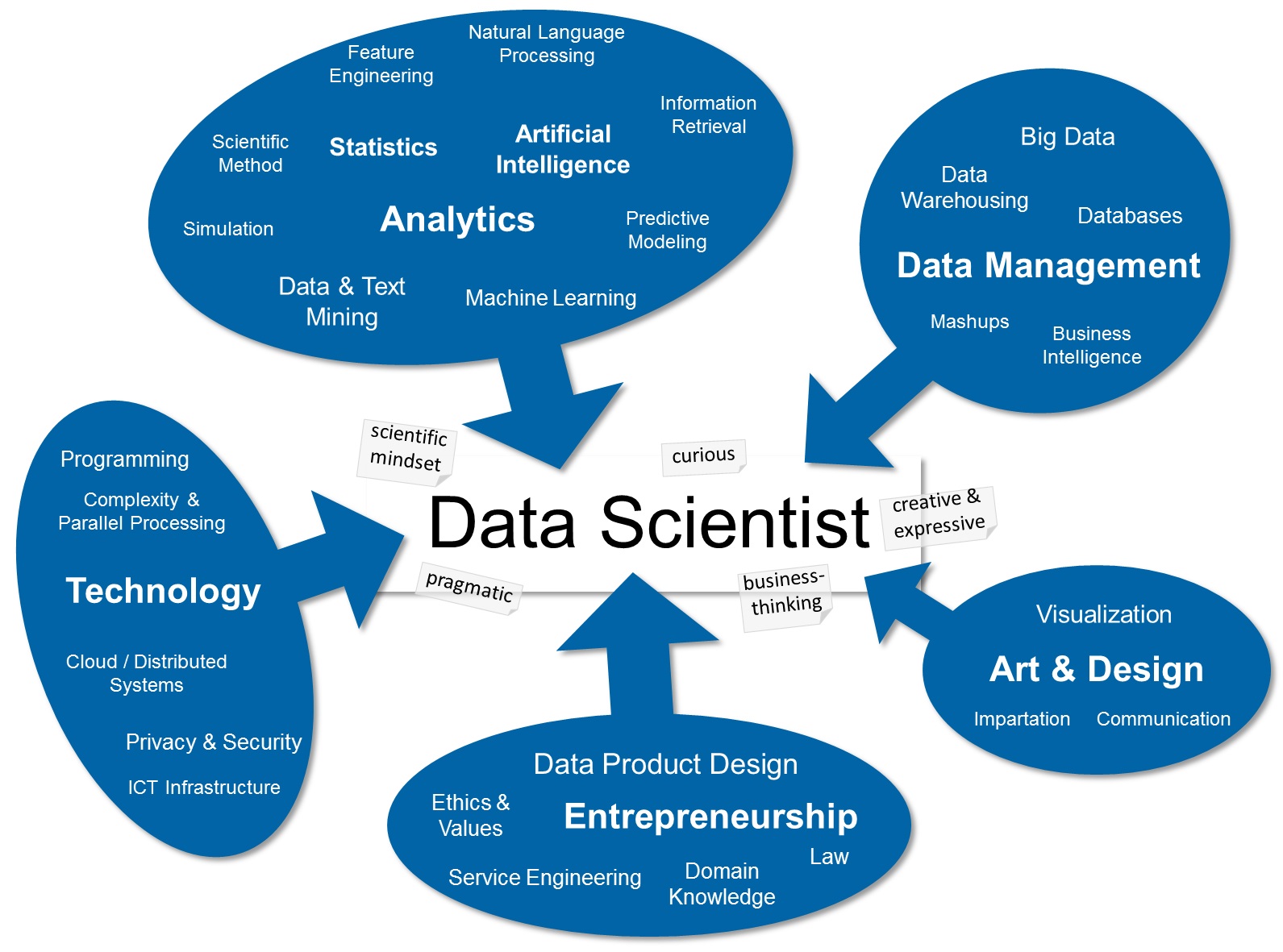
The book adopts the view that Data Science is a unique blend of skills from analytics, engineering & communication aiming at generating value from the data itself. It is inherently applied and interdisciplinary. The following skill set map of a data scientists gives an overview of this blend:
[
](http://stdm.github.io/images/apd-cover.jpg)
## Synopsis
While Data Science is somewhat a “hype topic” these days, and numerous books on the topic have been published recently, there is little literature that actually addresses the applied side of Data Science - which is, as we argue, where discussion of Data Science should actually start: as a discipline that blends and merges a diverse set of well-established research fields, Data Science is all about finding the right synergy to build exciting (and efficient) data products for projects both in academia and industry.
This volume highlights Data Science as something that is real, where technology is deployed in data-intensive projects, experiences are collected and lessons are learned. The book is clearly positioned as complementary to textbooks that cover the theoretical fundamentals of Data Science. While we start the book by including a “big picture” overview of the field Data Science, this overview is not intended to compete with the deep literature that exists for the fundamental research fields that underlie the discipline. Rather, by discussing the glue between these fields, we enable the reader to appreciate the discussion in the remainder of the book, which presents Data Science applications (the “Data Products”, or the use cases of data-driven businesses). This second part is the “meat” of the book: a number of chapters in collaboration has been co-developed with authors from academia and industry, where technology transfer in practice is described.
The book adopts the view that Data Science is a unique blend of skills from analytics, engineering & communication aiming at generating value from the data itself. It is inherently applied and interdisciplinary. The following skill set map of a data scientists gives an overview of this blend:
[ ](http://stdm.github.io/images/skillset.jpg)
## Target group
The book aims at learners and professionals in the academic and business sector:
* Professionals that are looking for applied data sciene or are working in the role of Data Scientist
* Decision-makers working in companies that are data-driven businesses
* Students that want to broaden their understanding of the disciplines that underlie data science and their application
* Researchers in specific areas of DS wanting to see the bigger picture
## Table of contents
#### Part I - The big picture
Part I introcuces the main topic: What is applied data science? What is a data product? And what traits do successful data scientists have? It then approaches important aspects of societal integration of data science, namely legal aspects as well as risks and side effects.
* [*Preface*](https://stdm.github.io/downloads/papers/ADS_2019_Preface.pdf) by the editors
* [*Introduction to Applied Data Science*](https://stdm.github.io/downloads/papers/ADS_2019_Introduction.pdf) by Stadelmann et al.
* [*Data Science*](https://stdm.github.io/downloads/papers/ADS_2019_DataScience.pdf) by Braschler et al.
* [*Data Scientists*](https://stdm.github.io/downloads/papers/ADS_2019_DataScientists.pdf) by Stadelmann et al.
* [*Data Products*](https://stdm.github.io/downloads/papers/ADS_2019_DataProducts.pdf) by Meierhofer et al.
* *Legal Aspects* by Hegyi et al.
* *Risks and Side Effects* by Cap
#### Part II - Nuts & bolts of Data Science
Part II is a curated collection of guest contributions emphasizing the "lessons learned" in various data science analyses. It covers topics such as methodical aspects (e.g. text analysis, machine learning, visualization, small/big data or modern analysis workflows), application fields (such as industry 4.0, finance, life sciences, health or security) and overarching principles (like what is great DS research? What are legal and ethical implications of data science?).
* *What is Data Science?* by Brodie
* *On developing Data Science* by Brodie
* *The ethics of Big Data applications in the consumer sector* by Christen et al.
* *Statistical Modelling* by Ruckstuhl & Dettling
* [*Beyond ImageNet - Deep Learning in Industrial Practice*](https://stdm.github.io/downloads/papers/ADS_2019_DeepLearning.pdf) by Stadelmann et al.
* *The Beauty of Small Data – an Information Retrieval Perspective* by Braschler
* *Narrative Visualization of Open Data* by Ackermann & Stockinger
* *Security of Data Science and Data Science for Security* by Tellenbach et al.
* *Online Anomaly Detection over Big Data Streams* by Rettig et al.
* [*Unsupervised Learning and Simulation for Complexity Management in Business Operations*](https://stdm.github.io/downloads/papers/ADS_2019_Complexity.pdf) by Hollenstein et al.
* *Data Warehousing and Exploratory Analysis for Market Monitoring* by Geiger & Stockinger
* *Mining Human Behavior Datasets for Insight, Prediction, and Planning* by Leidig & Wolffe
* *Economic Measures of Forecast Accuracy for Demand Planning - A Case-Based Discussion* by Ott et al.
* *Large-Scale Data-Driven Financial Risk Assessment* by Breymann et al.
* *Governance and IT Architecture* by Bignens et al.
* *Image Analysis at Scale for Finding the Links between Structure and Biology* by Mader
#### Part III - Lessons learned
Part III, written by the editors, reflects on the major data science technologies and their relations to the subdisciplines and application fields, together with a summary of the "lessons learned" from all contributed chapters. Based on these, the chapter [*Lessons Learned from Challenging Data Science Case Studies*](https://stdm.github.io/downloads/papers/ADS_2019_LessonsLearned.pdf) highlights future directions for the field and society at large.
](http://stdm.github.io/images/skillset.jpg)
## Target group
The book aims at learners and professionals in the academic and business sector:
* Professionals that are looking for applied data sciene or are working in the role of Data Scientist
* Decision-makers working in companies that are data-driven businesses
* Students that want to broaden their understanding of the disciplines that underlie data science and their application
* Researchers in specific areas of DS wanting to see the bigger picture
## Table of contents
#### Part I - The big picture
Part I introcuces the main topic: What is applied data science? What is a data product? And what traits do successful data scientists have? It then approaches important aspects of societal integration of data science, namely legal aspects as well as risks and side effects.
* [*Preface*](https://stdm.github.io/downloads/papers/ADS_2019_Preface.pdf) by the editors
* [*Introduction to Applied Data Science*](https://stdm.github.io/downloads/papers/ADS_2019_Introduction.pdf) by Stadelmann et al.
* [*Data Science*](https://stdm.github.io/downloads/papers/ADS_2019_DataScience.pdf) by Braschler et al.
* [*Data Scientists*](https://stdm.github.io/downloads/papers/ADS_2019_DataScientists.pdf) by Stadelmann et al.
* [*Data Products*](https://stdm.github.io/downloads/papers/ADS_2019_DataProducts.pdf) by Meierhofer et al.
* *Legal Aspects* by Hegyi et al.
* *Risks and Side Effects* by Cap
#### Part II - Nuts & bolts of Data Science
Part II is a curated collection of guest contributions emphasizing the "lessons learned" in various data science analyses. It covers topics such as methodical aspects (e.g. text analysis, machine learning, visualization, small/big data or modern analysis workflows), application fields (such as industry 4.0, finance, life sciences, health or security) and overarching principles (like what is great DS research? What are legal and ethical implications of data science?).
* *What is Data Science?* by Brodie
* *On developing Data Science* by Brodie
* *The ethics of Big Data applications in the consumer sector* by Christen et al.
* *Statistical Modelling* by Ruckstuhl & Dettling
* [*Beyond ImageNet - Deep Learning in Industrial Practice*](https://stdm.github.io/downloads/papers/ADS_2019_DeepLearning.pdf) by Stadelmann et al.
* *The Beauty of Small Data – an Information Retrieval Perspective* by Braschler
* *Narrative Visualization of Open Data* by Ackermann & Stockinger
* *Security of Data Science and Data Science for Security* by Tellenbach et al.
* *Online Anomaly Detection over Big Data Streams* by Rettig et al.
* [*Unsupervised Learning and Simulation for Complexity Management in Business Operations*](https://stdm.github.io/downloads/papers/ADS_2019_Complexity.pdf) by Hollenstein et al.
* *Data Warehousing and Exploratory Analysis for Market Monitoring* by Geiger & Stockinger
* *Mining Human Behavior Datasets for Insight, Prediction, and Planning* by Leidig & Wolffe
* *Economic Measures of Forecast Accuracy for Demand Planning - A Case-Based Discussion* by Ott et al.
* *Large-Scale Data-Driven Financial Risk Assessment* by Breymann et al.
* *Governance and IT Architecture* by Bignens et al.
* *Image Analysis at Scale for Finding the Links between Structure and Biology* by Mader
#### Part III - Lessons learned
Part III, written by the editors, reflects on the major data science technologies and their relations to the subdisciplines and application fields, together with a summary of the "lessons learned" from all contributed chapters. Based on these, the chapter [*Lessons Learned from Challenging Data Science Case Studies*](https://stdm.github.io/downloads/papers/ADS_2019_LessonsLearned.pdf) highlights future directions for the field and society at large.