Django Ledger supports:
- Chart of Accounts.
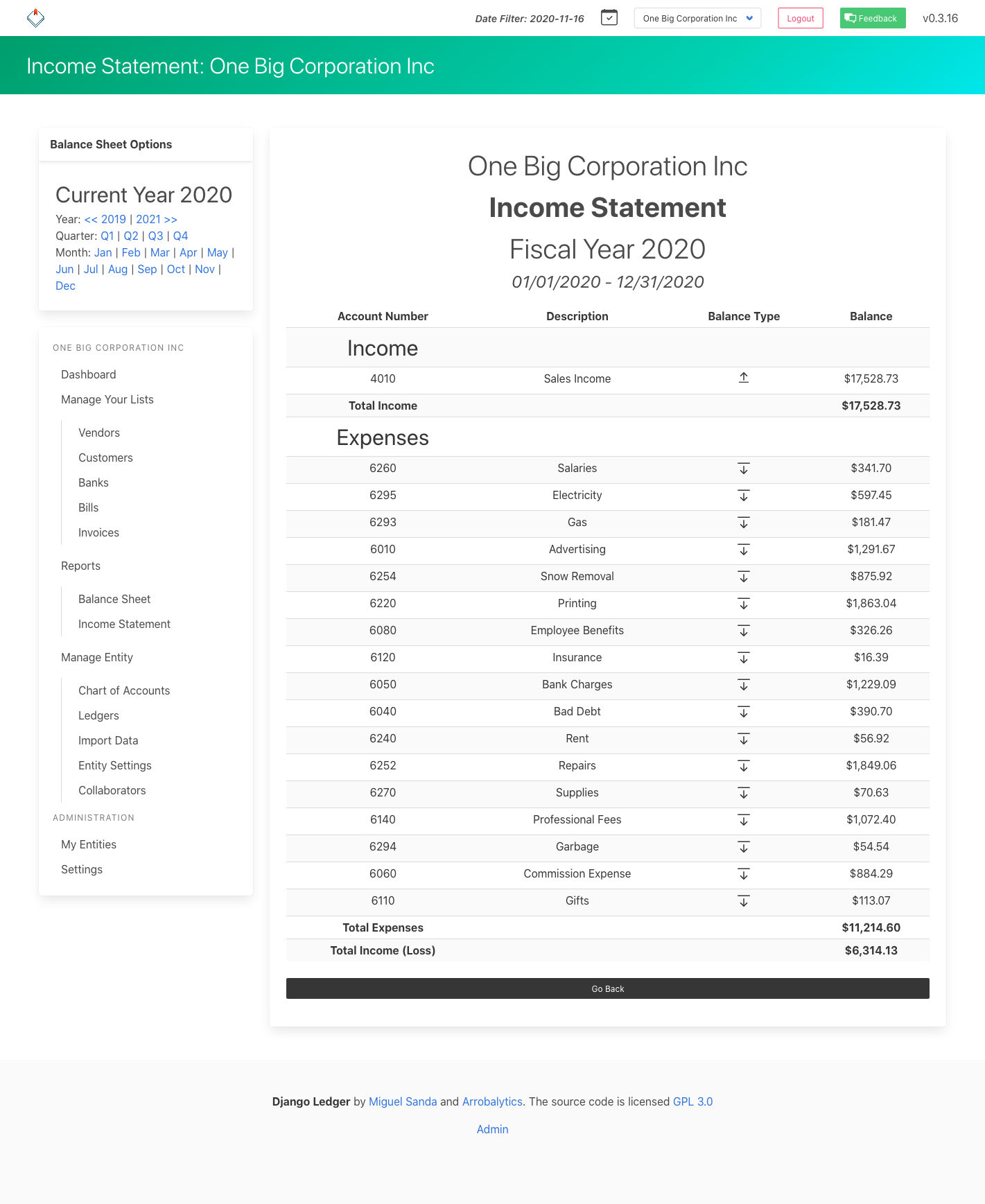
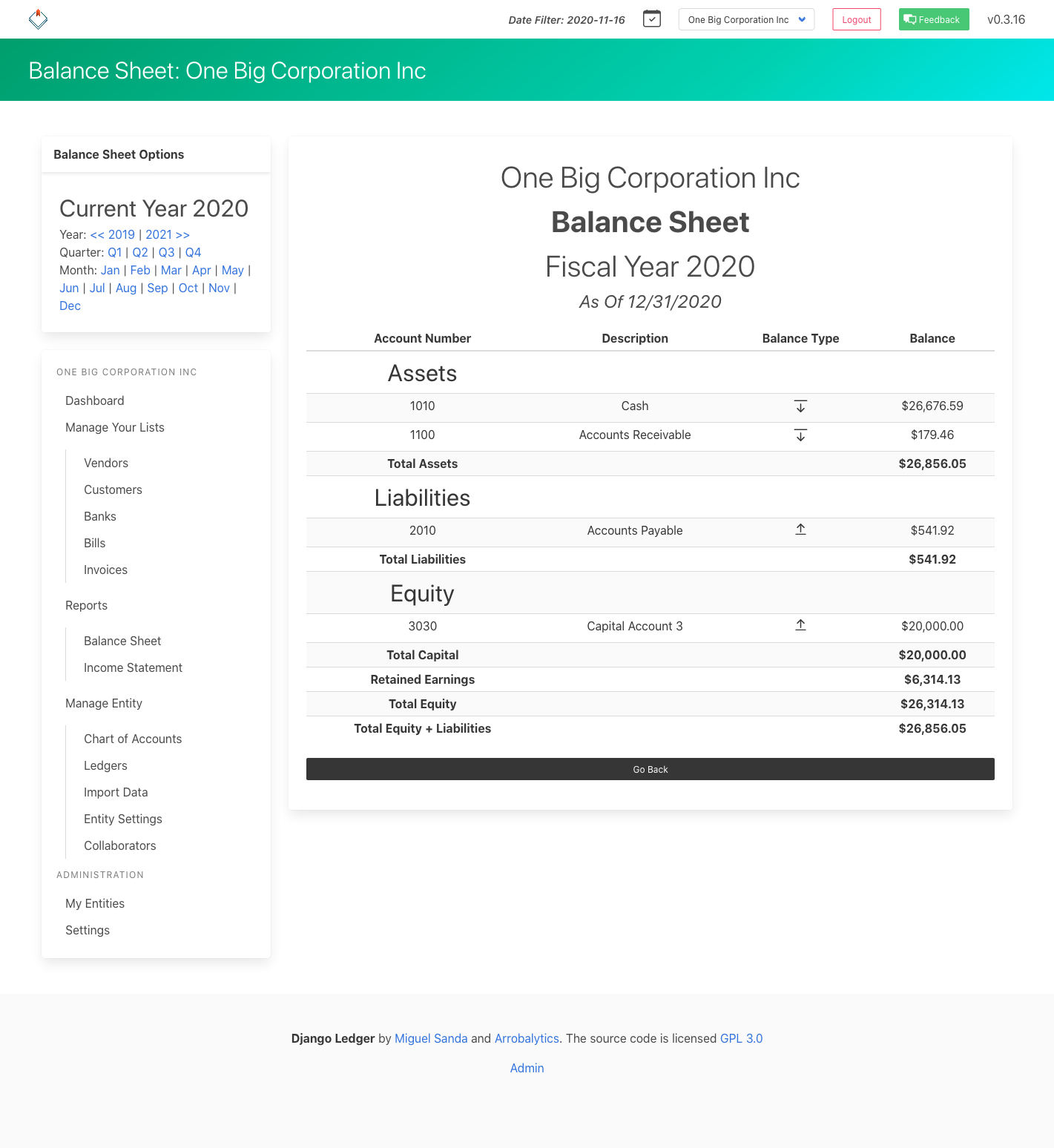
- Financial Statements (Income Statement & Balance Sheets).
- Automatic financial ratio & insight calculations.
- Multi tenancy.
- Hierarchical entity management.
- Self-contained Ledgers, Journal Entries & Transactions.
- Financial Activities Support (operational/financial/investing).
- Basic OFX & QFX file import.
- Bills & Invoices with optional accruable functionality.
- Basic navigational templates.
- Entity administration & entity manager support.
- Bank Accounts.
WARNING: Currently this project is under active development, it is not stable and is not recommended for production environments. Breaking changes may occur in future releases. The author is actively working to provide a stable release as soon as possible and to incorporate the following functionality:
- Cash flow statement.
- Inventory Management.
- Entity Nesting and Corporate Structures.
- Tax line mapping.
- Package documentation.
- Collaborators & Permissions.
- Extensible API & Object Oriented Accounting.
- Unit Tests & Behavior Driven Development Tests.
- And a lot more stuff...
For more details please check our full v1.0 Roadmap.
This project is actively looking for contributors. Any financial and/or accounting experience is a big plus. If you have prior accounting experience and want to contribute, don't hesitate to contact me.
Django Ledger comes with a default CoA ready to use or you could use your own. Make sure to select the appropriate option when creating new entities.
- Install Django Ledger
pip install git+https://github.com/arrobalytics/django-ledger.git- Add django_ledger to INSTALLED_APPS
INSTALLED_APPS = [
    ...,
    'django_ledger',
    ...,
]- Add URLs to your project:
urlpatterns = [
    ...,
    path('ledger/', include('django_ledger.urls', namespace='django_ledger')),
    ...,
]