Add HIIR library to LMMS #6553
Merged
Add HIIR library to LMMS #6553
Conversation
This file contains hidden or bidirectional Unicode text that may be interpreted or compiled differently than what appears below. To review, open the file in an editor that reveals hidden Unicode characters.
Learn more about bidirectional Unicode characters


Contributor
|
Why not add this library as a Git Submodule? |

sakertooth
approved these changes
Jan 21, 2023


JohannesLorenz
approved these changes
Jan 23, 2023
Contributor
 JohannesLorenz
left a comment
JohannesLorenz
left a comment
JohannesLorenz
left a comment
There was a problem hiding this comment.
A bit weird to add code that is not used, but I can't see errors in the code.

Contributor
Just so we can see what the license is here without having to look it up. 👍 http://www.wtfpl.net/ |

DomClark
reviewed
Jan 23, 2023

messmerd
approved these changes
Jan 25, 2023
DomClark
approved these changes
Jan 26, 2023

LostRobotMusic
added a commit
that referenced
this pull request
Jan 26, 2023
This reverts commit 4d1d887.
This was referenced Jan 26, 2023
sakertooth
pushed a commit
to sakertooth/lmms
that referenced
this pull request
May 30, 2023

sakertooth
pushed a commit
to sakertooth/lmms
that referenced
this pull request
May 30, 2023
Sign up for free
to join this conversation on GitHub.
Already have an account?
Sign in to comment
6 participants


Add this suggestion to a batch that can be applied as a single commit.
This suggestion is invalid because no changes were made to the code.
Suggestions cannot be applied while the pull request is closed.
Suggestions cannot be applied while viewing a subset of changes.
Only one suggestion per line can be applied in a batch.
Add this suggestion to a batch that can be applied as a single commit.
Applying suggestions on deleted lines is not supported.
You must change the existing code in this line in order to create a valid suggestion.
Outdated suggestions cannot be applied.
This suggestion has been applied or marked resolved.
Suggestions cannot be applied from pending reviews.
Suggestions cannot be applied on multi-line comments.
Suggestions cannot be applied while the pull request is queued to merge.
Suggestion cannot be applied right now. Please check back later.
A crucial library for high-performance oversampling within LMMS, licensed under WTFPL.
There are many situations within LMMS that require oversampling. The quality of oversampling is heavily determined by the filters used in the process... the ideal is to have as steep of a filter slope as possible (to remove all aliasing without the filtering being audible at all) while also introducing minimal phase shifting (or else the filtering will audibly smear the audio).
Generic Butterworth lowpass filters are not adequate for this goal. In order for the desired steep slope to be achieved, it would be necessary to stack a very large number of these filters on top of each other, which results in tons of audible phase shifting and quite a hefty CPU demand.
An idealized FIR filter also won't work in many situations... the number of taps required to make the filter usable will result in large amounts of latency and quite a massive CPU demand once again.
HIIR solves this by using a different type of IIR filter called an elliptic filter, which is characterized by having an extremely steep slope with minimal filter taps.
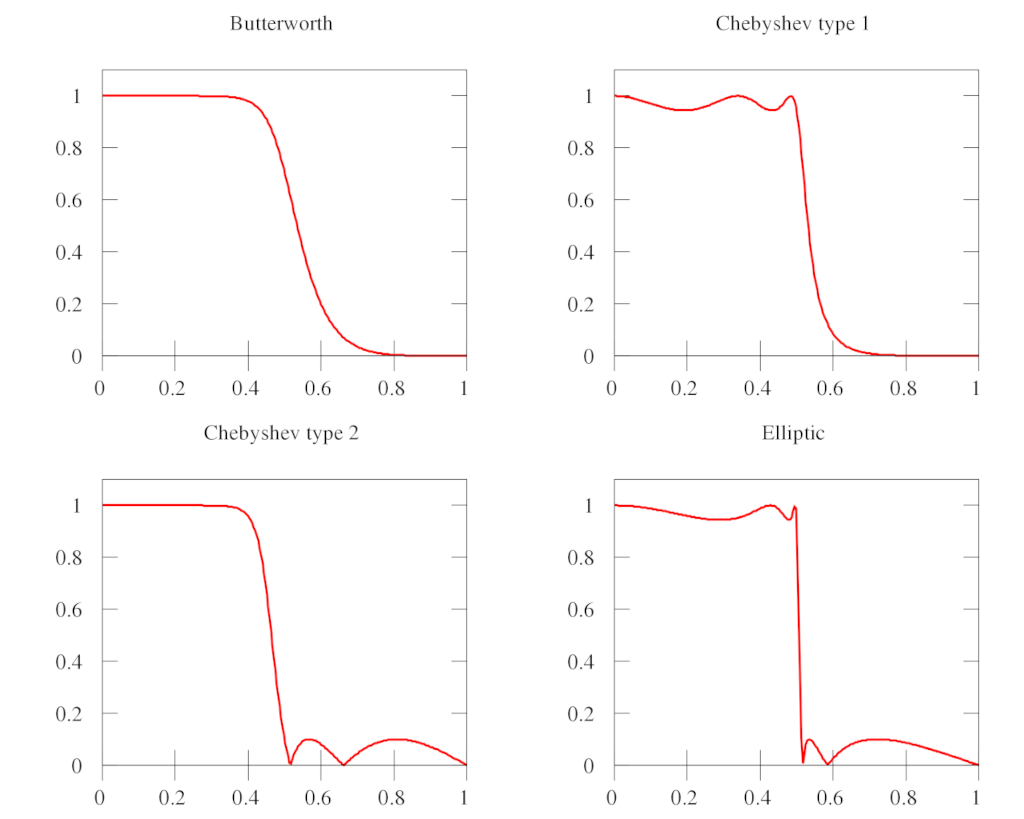
Butterworth filters have such a gentle slope because they are designed to have minimal passband and stopband rippling. Elliptic filters allow a small amount of rippling and are able to have a far steeper slope as a result. Conveniently, this ripple is mostly only audible near the cutoff frequency, which is not an issue when you're filtering near Nyquist at frequencies too high for a human to hear.
The filters within HIIR are designed specifically with oversampling in mind, and will be the best things to use in almost all cases where oversampling is required. It also comes with some other useful filters which work in similar ways, like an IIR Hilbert Transform which shifts the audio by 90 degrees (an essential ingredient for frequency shifting).
I'll be modifying #6540 to make use of this library once it is added.