Copy reference type default attributes when creating a new block #10890
Conversation


 talldan
added
[Type] Bug
talldan
added
[Type] Bug

| // If the type of the attribute's default is a reference type, | ||
| // make a copy so that implementors cannot easily mutate the | ||
| // block type's default attributes. | ||
| if ( Array.isArray( defaultValue ) ) { |
There was a problem hiding this comment.
Not sure if we should consider deep cloning? Having said that, everything worked ok in my tests.

There was a problem hiding this comment.
Not sure if deep cloning would be worth the slight performance penalty.
To simplify this if, could we use _.clone?
There was a problem hiding this comment.
Nice! I was sure I searched for a clone in the lodash docs and couldn't find anything, but there it is, clear as day.


| // Mutate the array attribute and assert the original | ||
| // default wasn't also mutated. | ||
| block.attributes.content[ 0 ] = 'test'; | ||
| expect( block.attributes.content ).not.toEqual( arrayDefault ); |
There was a problem hiding this comment.
Technically speaking, you could also verify before mutation happens the following:
expect( block.attributes.content ).not.toBe( arrayDefault );which check whether they are equal and share the same reference.
| // make a copy so that implementors cannot easily mutate the | ||
| // block type's default attributes. | ||
| if ( Array.isArray( defaultValue ) ) { | ||
| defaultValue = defaultValue.slice(); |
There was a problem hiding this comment.
You can also use ES6 syntax, not sure if it is faster though:
defaultValue = [ ...defaultValue ];
defaultValue = { ...defaultValue }; but it's shorter for sure :)
 gziolo
left a comment
gziolo
left a comment
gziolo
left a comment
There was a problem hiding this comment.
It looks like a legit fix. I would appreciate having confirmation from @aduth, @youknowriad or @iseulde that it doesn't bite us in other aspects. Do you think there might be other methods which need to be verified?

 aduth
left a comment
aduth
left a comment
aduth
left a comment
There was a problem hiding this comment.
Preemptively blocking the merge to allow discussion.
My initial impression: This code is "doing it wrong" for more reason than one:
onClick={ () => {
  testAttribute.newProperty = 'test';
  setAttribute( { testAttribute } );
} }
| // block type's default attributes. | ||
| if ( Array.isArray( defaultValue ) ) { | ||
| defaultValue = defaultValue.slice(); | ||
| } else if ( typeof defaultValue === 'object' ) { |

|
I don't think we want this. Block implementers should not be mutating attributes directly, as it will have very unpredictable and buggy behavior in how attributes are referenced. It's much the same (in fact, literally the same, since it is in state) as Redux's read-only state principle: https://redux.js.org/introduction/threeprinciples#state-is-read-only If we want a developer experience improvement, I think we should do so by (deep-)freezing the attribute value so that it never gives any impression of working at all. |

|
@aduth - I recommended a non-mutating fix to the block implementor in slack, and I agree with that concept. I did pause before creating this PR, considering whether it was necessary, and after some thought my opinion was that this is a bug. That's purely because I don't think any actions within a created block should cause the original definition to change. I think this could be considered synonymous to a created React component somehow causing the initial declaration of the component to be modified—even though those APIs encourage non-mutation there's still a level of protection. When working within a component or a block, I'd have an expectation that changes do not leak out—a created block should potentially be its own sandbox—I could screw up that one instance by triggering a mutation, but it shouldn't affect others that haven't undergone the mutation. I think there's also a dev experience aspect. I'm sure a lot of block builders are learning both React and Gutenberg (and possibly functional concepts) at the same time, so it might be good to offer a bit more implicit safety. |
Can you elaborate on this? What protection are you referring to? By contrast, if you mutate a prop in a React component which had been provided through a https://codepen.io/aduth/pen/PyVXZZ
But the example from the original comment still wrong and error-prone in its state-mutating nature, even with the clone behavior. |
That potentially buggy code is contained/localized and doesn't cause issues more widespread than needed.
I'm surprised by that.
I worry that it's not clear enough to block implementors why mutation is a problem—there's no developer feedback that the mutation is an error. Bugs caused by mutations could be quite subtle and hard to spot. I also couldn't find much (or anything) in the handbook to explain why attributes shouldn't be mutated, but I could've missed it. Maybe there's an assumption that implementors understand the paradigm from using React/Redux. Perhaps at the very least this PR can be replaced with another one that adds more information to the docs? |
I'm fine with that. I also don't mind the idea of applying |
|
Also worth noting that conveniences don't make things simpler when in the broader sense we don't apply the conveniences consistently. If I receive positive or negative feedback in mutating attributes, will it alter my expectations in cases where I may be tempted to try the same (e.g. adding a new property to the return value of |

Getting off topic here, but I keep thinking that WordPress needs a Developer Mode switch in WP Admin which enables extra warnings. |


|
I haven't tested, but this may fix #11705 |
|
Just to update on this:
|


Description
This is a small fix to make sure that the default attributes for a block type cannot be mutated within a block instance's edit method.
This issue originated from a message in the #core-editor channel in slack: https://wordpress.slack.com/archives/C02QB2JS7/p1540130491000100
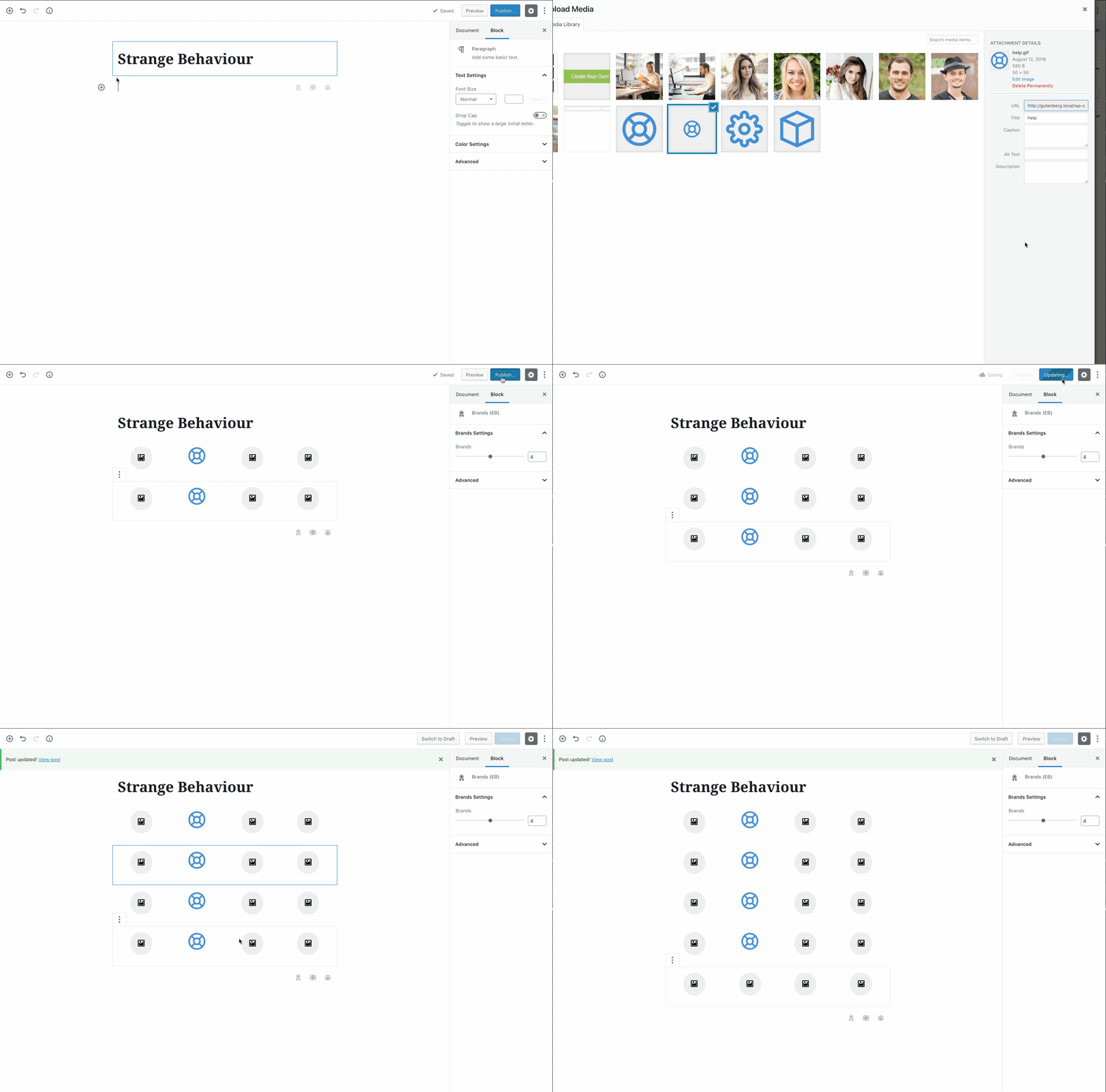
After some investigation I discovered that createBlock passes default objects and arrays by reference instead of copying/cloning them when createBlock is called, leading to unexpected results if those references are mutated. To make things easier for block implementors, the solution in this PR is to copy those defaults in
createBlock.How has this been tested?
Then to test this custom block:
Screenshots
This issue can result in the behaviour where the default attribute is mutated in the first block, and then successive new blocks when added also use the mutated default:
Types of changes
Bug fix (non-breaking change which fixes an issue)
Checklist: