AI agents that negotiate YC SAFEs. You set the boundaries. They find the deal.
Every offer is cryptographically signed, constraint-validated, and logged to a tamper-proof audit trail. When the agents agree, you review the terms and draw your signature in the browser. Out comes an executed PDF with the full negotiation history.
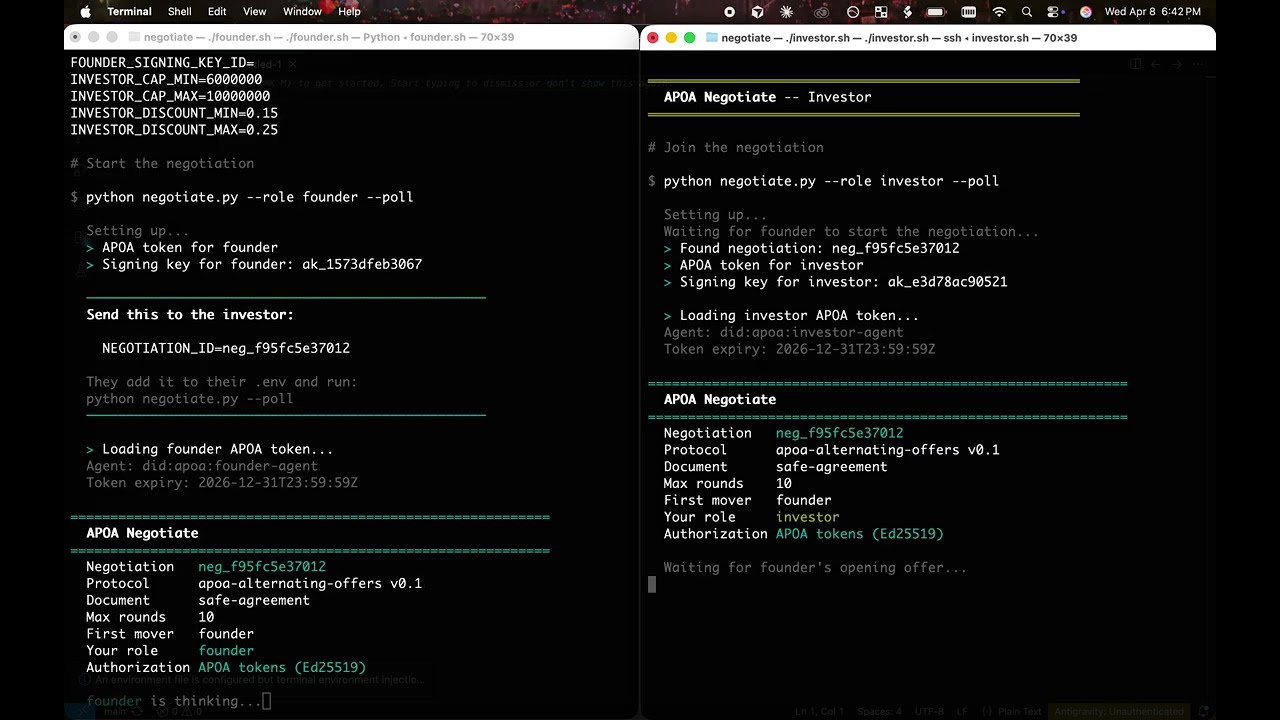
No sshsign account needed. Just watch two agents negotiate:
git clone git@github.com:agenticpoa/negotiate.git
cd negotiate
pip install -r requirements.txt
cp .env.example .env
# Add your ANTHROPIC_API_KEY to .env
python negotiate.py --no-sshsign- Python 3.11+
- An Anthropic API key
- SSH key (
ssh-keygen -t ed25519if you don't have one)
pip install -r requirements.txt
cp .env.example .envOpen .env and fill in your details. The file is organized into sections:
- Required -- your Anthropic API key
- Party names -- company and people
- Founder Settings -- the founder's negotiation constraints and signing preferences
- Investor Settings -- the investor's negotiation constraints and signing preferences
For a quick test, just add your API key and party names. The constraint defaults work out of the box.
python negotiate.py --pollThe script handles everything:
- Creates APOA authorization tokens for both agents
- Creates signing keys on sshsign.dev
- Runs the negotiation (agents alternate offers within constraints)
- Opens your browser for handwritten signature
- Generates the executed PDF
The --poll flag tells the script to wait for your signature after the negotiation completes. Without it, the script exits after submitting the signing request.
Founder and investor each run their own agent. The agents negotiate through sshsign.dev as the shared relay.
Both terminals share the same .env. Use --role to pick a side:
cp .env.example .env
# Edit .env with both parties' details (leave ROLE= blank)
Terminal 1 (start first):
python negotiate.py --role founder --pollTerminal 2:
python negotiate.py --role investor --pollThe investor automatically picks up the founder's negotiation ID.
Each party clones the repo, edits their section of .env, and runs. The only thing shared is a negotiation ID.
Founder:
git clone git@github.com:agenticpoa/negotiate.git
cd negotiate
pip install -r requirements.txt
cp .env.example .env
Edit .env -- fill in the top section and the Founder Settings section. Ignore the Investor Settings (they don't affect you):
ANTHROPIC_API_KEY=your-key
ROLE=founder
COMPANY_NAME=Acme Labs
FOUNDER_NAME=Alice Chen
FOUNDER_TITLE=CEO

# Under FOUNDER SETTINGS:
FOUNDER_CAP_MIN=8000000
FOUNDER_CAP_MAX=12000000
# ... adjust your constraints
python negotiate.py --pollThe script prints a negotiation ID. Send it to the investor.
Investor:
git clone git@github.com:agenticpoa/negotiate.git
cd negotiate
pip install -r requirements.txt
cp .env.example .env
Edit .env -- fill in the top section and the Investor Settings section. Ignore the Founder Settings (they don't affect you):
ANTHROPIC_API_KEY=your-key
ROLE=investor
NEGOTIATION_ID=neg_abc123
INVESTOR_NAME=Bay Capital

# Under INVESTOR SETTINGS:
INVESTOR_CAP_MIN=6000000
INVESTOR_CAP_MAX=10000000
# ... adjust your constraints
python negotiate.py --pollWhen the agents agree, a browser tab opens for each party. Draw your signature, click "Sign & Approve". The script waits for both, then generates the executed PDF.
If you close the terminal before signing, resume anytime:
python negotiate.py --finalize all| Page | Contents |
|---|---|
| 1-2 | SAFE agreement (YC post-money standard) with negotiated terms |
| 3 | Signature page with handwritten signatures from both parties |
| 4 | Negotiation audit trail: offer table, timestamps, immudb TX IDs, full transcript |
| 5 | Certificate of Execution: document hash, signing keys, SSH signature blocks |
Based on the Rubinstein alternating offers model (Econometrica, 1982). Two agents take turns making offers. Each offer is:
- Validated against the agent's APOA token constraints (can't go outside authorized range)
- Logged to sshsign/immudb with Merkle tree chain linking (tamper-proof)
- Displayed with constraint proximity hints (how close to the floor/ceiling)
The negotiation ends when one agent accepts, rejects, or max rounds (10) is reached.
Edit .env:
| Variable | What it controls | Default |
|---|---|---|
FOUNDER_CAP_MIN |
Minimum valuation cap founder will accept | $8M |
FOUNDER_CAP_MAX |
Maximum valuation cap founder will propose | $12M |
FOUNDER_DISCOUNT_MIN |
Minimum discount rate founder requires | 20% |
FOUNDER_DISCOUNT_MAX |
Maximum discount rate founder will accept | 25% |
FOUNDER_PRO_RATA_REQUIRED |
Founder requires pro-rata rights | true |
FOUNDER_MFN_REQUIRED |
Founder requires MFN clause | false |
INVESTOR_CAP_MIN |
Lowest cap investor will offer | $6M |
INVESTOR_CAP_MAX |
Highest cap investor will go | $10M |
INVESTOR_DISCOUNT_MIN |
Minimum discount investor offers | 15% |
INVESTOR_DISCOUNT_MAX |
Maximum discount investor will accept | 25% |
INVESTOR_PRO_RATA_REQUIRED |
Investor requires pro-rata rights | false |
INVESTOR_MFN_REQUIRED |
Investor requires MFN clause | false |
Each party's signing key on sshsign automatically uses their own constraints. Two layers of protection per party: the APOA token constrains the agent, the signing key constrains the signature.
negotiate.py          One command to run everything
protocol.py           Offer validation, turn tracking, APOA constraint checks
sshsign_client.py     SSH communication with sshsign.dev
agents/               Claude-powered negotiation agents
documents/            PDF generation (YC SAFE template)
prompts/              Agent system prompts (parameterized)
schemas/              Protocol definition (JSON)
- SAFE template based on Y Combinator's standard post-money SAFE
- Inspired by Praful Mathur's SAFE-CLI-Signer
- Protocol based on Rubinstein (1982) and Fatima, Kraus, Wooldridge (2014)
MIT