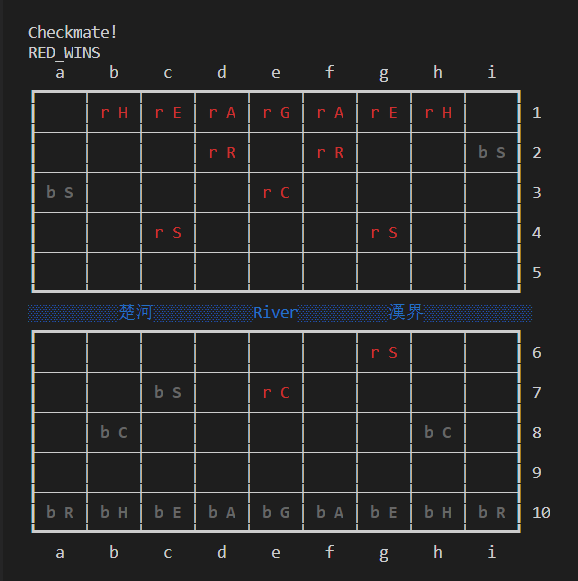
Description: Implemenation of Chinese Chess (Xiangqi) in Python. The rules can be found here (https://en.wikipedia.org/wiki/Xiangqi).
-
This game is played using algebraic notation to represent the squares on the board. For example, "a4" represents the piece in column "a" and row "4".
-
To play, initiate an instance of the XiangqiGame class. For example: game = XiangqiGame().
-
Next, include the following two lines to print the board and display the current state of the game (UNFINISHED, RED_WINS, or BLACK_WINS, respectively)
*print(game.get_game_state())
*game.print_board()
-
Finally, players move using the command: game.make_move("square from", "square_to")
*For example, to move the red general one square forward from his starting position, enter: game.make_move("e1", "e2")
-
make_move() will return True if the move is valid, otherwise it will return False. If a player enters an invalid move, it remains their turn until they have played a valid move.
-
The game continues until one side has placed the other side's general in checkmate, where they have no valid moves to escape.
-
Red has the first move.