Exponential curves #568
Exponential curves #568
Conversation


|
How can you find/calculate the insulinPeakTime that must be used? |

|
@PieterGit Start with DIA=5 and curve = fiasp. The peak time defaults to 55, which is the "official" peak from Novo. |
|
Oops, @PieterGit the peak time setting is currently only supported for Fiasp. I'll look at adding it for Novo, too. |

 mgranberryto
left a comment
mgranberryto
left a comment
mgranberryto
left a comment
There was a problem hiding this comment.
This has nothing to do with this PR per se, but I have noticed a recent performance regression that I noticed when I started using the exponential curves.
I had gone a while between loop updates prior to implementing the exponential curves so this isn't necessarily the cause, but oref0-meal has gone from returning almost instantaneously to requiring well over a minute to execute in my loop. I don't know whether it's because the IOB formula is now significantly more resource-intensive to calculate (non-integral powers are computationally expensive) or because oref0-meal is operating on significantly more data with the merged pump history or both, but it is leading to a non-trivial amount of extra load on my Edison and I can no longer loop through the night if I forget to plug in at night. SMB boluses are also coming in minutes later now, which should lead to more control instability. It's small, but small things add up.
I have thought about pre-calculating the iob/activity values for "1 unit" from 0 ... dia minutes and returning those cached values scaled by the insulin dose. It would also be possible to calculate the current insulin math as a cross-correlation of the IOB and activity arrays with a per-minute insulin delivery vector. In an experiment in Python I found that to result in near-instantaneous all-day calculations, but I haven't gone through the effort of implementing it in JavaScript.
lib/iob/calculate.js
Outdated
|
|
||
| if (treatment.insulin) { | ||
| var bolusTime = new Date(treatment.date); | ||
| var minAgo = diaratio * (time - bolusTime) / 1000 / 60; |
There was a problem hiding this comment.
If you have the spreadsheet up, I'd like to see how the peak time adjustments affect NovoRapid too. This looks to me like it will completely break as it currently stands.
There was a problem hiding this comment.
Changed the code so it uses 75 minutes as the baseline for Novo.
lib/iob/calculate.js
Outdated
|
|
||
| curve = curve.toLowerCase(); | ||
|
|
||
| if (curve != 'novorapid' && curve != 'fiasp') { |
There was a problem hiding this comment.
I know I didn't include it in the code you started with, but it is probably worth including 'novolog' as a curve option too, as an alias for 'novorapid'.
There was a problem hiding this comment.
👍 Renamed the curves to generic names, will push soon.
lib/iob/calculate.js
Outdated
| return; | ||
| } | ||
|
|
||
| var usePeakTime = false; |
There was a problem hiding this comment.
It's a nitpick, but it looks like indentation is irregular here. It's probably worth cleaning this up or using an editor to reformat the function.
lib/iob/calculate.js
Outdated
| console.error('Pump DIA must be set to 5 hours if using the Insulin Peak Time setting'); | ||
|
|
||
| if (profile.insulinPeakTime < 35 || profile.insulinPeakTime > 80) { | ||
| console.error('Insulin Peak Time is only supported for values between 35 to 80 minutes'); |
There was a problem hiding this comment.
Perhaps this should come earlier and it should be restricted to fiasp only.
There was a problem hiding this comment.
Added scaling for Novo, too, and expanded the range.
lib/iob/calculate.js
Outdated
|
|
||
| var diaratio = 5.0 / profile.dia; | ||
|
|
||
| if (profile.insulinPeakTime !== undefined) { |
There was a problem hiding this comment.
The indentation is different here too.
lib/iob/calculate.js
Outdated
|
|
||
| if (minAgo < end) { | ||
| if (curve.toLowerCase() === 'fiasp') { | ||
| iobContrib = treatment.insulin * (((minAgo / 55) + 1) * Math.exp(-(minAgo) / 55)); |
There was a problem hiding this comment.
Does the peak scaling change the AUC for activity? I haven't done the math, but it feels like it might. A normalization term might be needed.
There was a problem hiding this comment.
Yeah the AUC changes; here's what the AUC normalized curves look like. The change in the calculated activity is pretty dramatic, wonder if this would work.

|
My Excel that made the graphs |
…Novo peak scaling. AUC normalized for activity.
mgranberryto
left a comment
mgranberryto
left a comment
There was a problem hiding this comment.
It's a little tough seeing what changed in the tests through Github's interface. Did you just add a couple tests?
This appears to address the concerns that I had, aside from verifying that the peak-scaled and normalized IOB and activity formulas correspond with eachother. Intuitively they look like they should, but I haven't yet done the math.
tests/iob.test.js
Outdated
| afterDIA.bolussnooze.should.equal(0); | ||
| }); | ||
|
|
||
| it('should calculate IOB with Fiasp', function() { |
There was a problem hiding this comment.
Should this text be changed for consistency now that fiasp has been changed to ultrafast?
tests/iob.test.js
Outdated
| }); | ||
|
|
||
|
|
||
| it('should calculate IOB with Fiasp peak setting of 55', function() { |
lib/iob/calculate.js
Outdated
| console.error('Unsupported curve function: "' + curve + '". Supported curves: bilinear, novorapid and fiasp.'); | ||
| return; | ||
|
|
||
| if (curve != 'fast-acting' && curve != 'ultrafast') { |
There was a problem hiding this comment.
rapid-acting is the language commonly used in the USA for Novolog, Humalog, and Apidra, and short-acting for regular. Would rapid and ultra-rapid work better here?
| var y = (minAgo - peak) / 5; | ||
| iobContrib = treatment.insulin * (0.001323 * y * y - .054233 * y + .55556); | ||
| //activityContrib=sens*treatment.insulin*(2/dia/60-(minAgo-peak)*2/dia/60/(60*dia-peak)); | ||
| activityContrib = treatment.insulin * (2 / dia / 60 - (minAgo - peak) * 2 / dia / 60 / (60 * 3 - peak)); |
There was a problem hiding this comment.
I haven't tested this, but I want to verify that activity integrates to something ~= treatment.insulin post-scaling. Strange things will happen if it doesn't.
There was a problem hiding this comment.
This is the old algorithm, which I'm leaving exactly as-is

|
Thanks for making the effort to push this across the finish line. This is going to make a huge difference. |
|
@mgranberry thanks for the comments! Better get this right <3 |
|
Here's the current activity curve for rapid-acting model
|


|
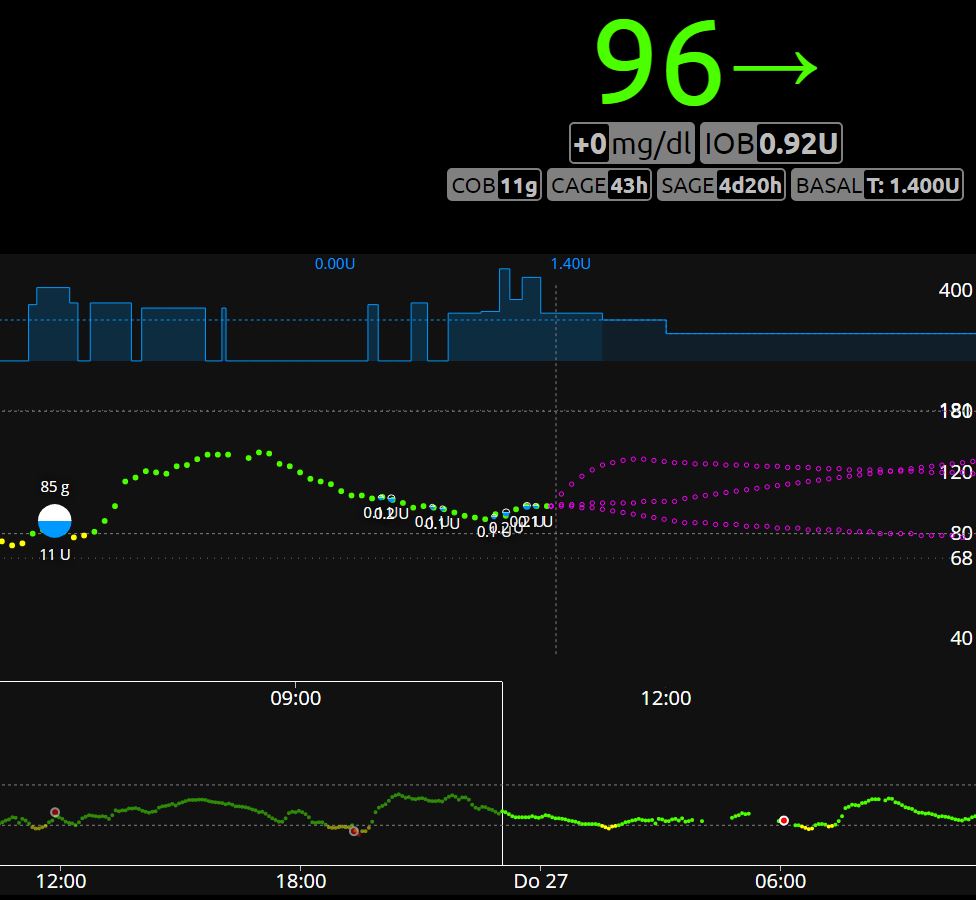
Have remaining 85U Humalog in my reservoir, with a new reservoir will give Fiasp a 2nd trial testing the curve adjustments |
|
testing this with jubi 0.2.0 rig on node 6.11.1 and with |
…g, added default curve to profile to ensure the correct curve is used
|
running now w/ Fiasp and |

|
If you're on this branch, please update to the latest push. I made a fix to the profile.json generation that ensures the new curves are actually being used at all times. |

|
Running this on a rig with default preferences (bilinear curve) to start with. The pump-loop is never completing before getting killed off. When I run it manually, it's getting stuck on some of the new code from #585. Moving the rest of my bug report over there for further discussion. |
 scottleibrand
force-pushed
the
0.6.0-dev
branch
from
scottleibrand
force-pushed
the
0.6.0-dev
branch
from
72a60d9 to
279750d
Compare


|
Given @sulkaharo 's investigations into the maths of the existing bilinear curves, is it worth leaving out the bilinear option and simply releasing 0.6.0 with the updated "rapid" and "ultra-rapid" curves? We know that these scale safely and produce good results, and it will remove the broken maths for bilinear in the process. |
|
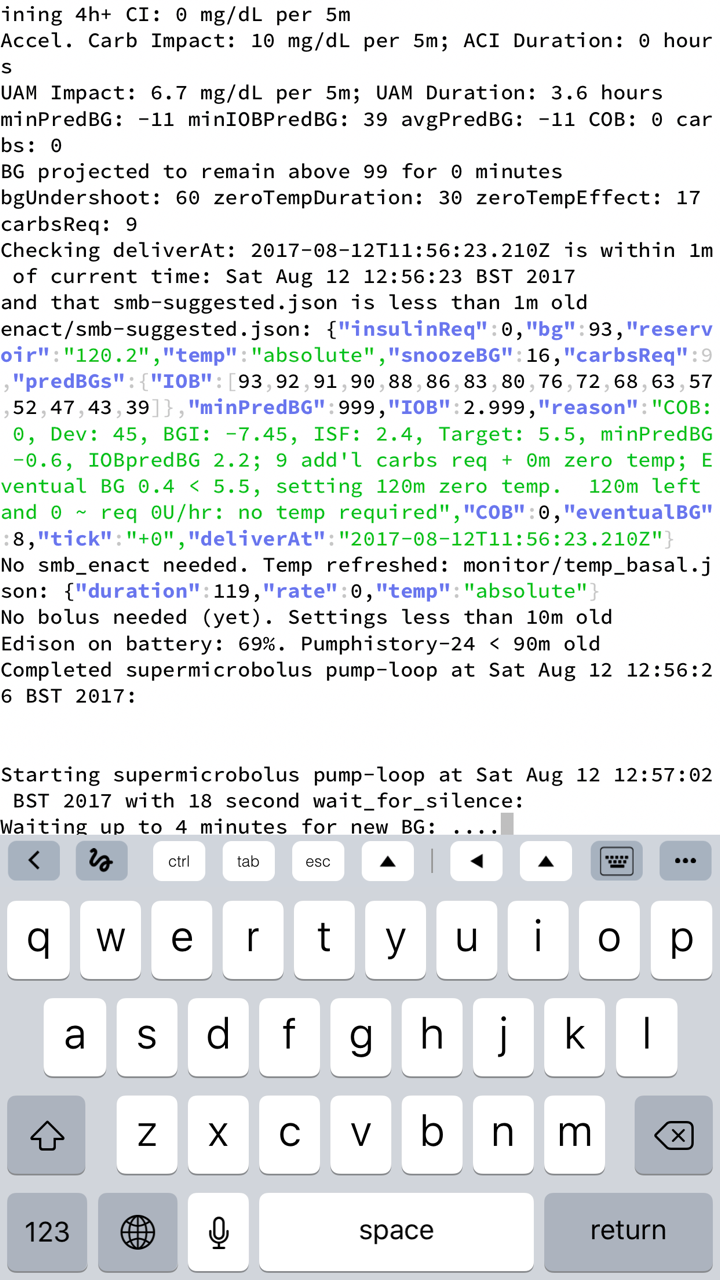
I'm running exponential curves branch on a rig with node 0.10.29, updated to the latest versions of the code. Preferences are: And the loop is running correctly. See logs:
|

|
does this change include a finer control over DIA (e.g., 4.5 hours vs 4 or 5)? or do you think i will no longer want that after using the new curves? right now 4 has trouble giving lows overnight and 5 doesn't quite get us down to target overnight, i'm hoping a longer autotune on 5 will fix that but not sure... |
|
@tynbendad With exponential curves, DIA is no longer used for calculating insulin IOB or action. |
|
thanks & great, that makes things simpler, i think... |
|
Q to the curve set in preference.json, any information in the log which curve is set? |
|
Not currently. Perhaps we should have determine-basal print the curve-related preferences? Want to PR that? |
|
@sulkaharo mentioned he was planning to add that. |
|
just curious in case its needed by someone someday, is it possible to add a curve for regular insulin ("R")? |
|
Possible, sure. Worth it? Most definitely not, until/unless someone needs it. |
|
To my eye a peak of 90 and dia of about 8h approximates R well enough, but there a lot of other assumptions being made in the system about insulin activity that make it a bigger task than it immediately appears to use "R." I suspect there aren't many (any?) users using OpenAPS with regular insulin. |
|
@scottleibrand : did you manage to resolve the stability issues you mentioned here #568 (comment) ? I ran the Do people use 0.6.0 with this |
|
I fixed the performance issues with some optimizations in 0.6.0-dev, but haven't retested Sulka's PR. We're using ultrarapid and it's working quite well. |
|
I've been running with ultra-rapid for weeks now with no stability issues. |

|
Should the line in preferences.json read From the code I would expect ultra-rapid without quotation marks but Tim`s example has quotation marks. What is the correct form? |
|
|
|
short Q, for the new curves I need to do a checkout |
|
Correct. We are just waiting for someone to have some time to do some documentation before we merge 0.6.0-dev to dev for broader testing. |


Implements #544 - needs testing help, do not merge until confirmed to work.
NOTE: consider testing this extremely experimental! This code branch implements the new exponential curve model for insulin activity. This is a fairly big change compared to the old bilinear model, so if you do participate in the testing of this feature, assume you will need to monitor your BG closely and might need to adjust your profile to fit.
The code now supports three new configuration variables in preferences.json:
In order to use the rapid-acting or ultra-rapid curves, your pump must be set to 5 hour DIA, or longer. 6 hours is recommended as the starting point.
The underlying mathematical model is developed by @dm61.
Below are the activity and IOB graphs at various DIA and peak values
Testing
Both Fiasp and Novorapid curves are modeled after 5 hour DIA (compared to 3 hour default DIA for the old model). Due to the curve shape, the insulin activity contribution at the 5 hour mark is extremely low but should model the actual insulin tail more effectively than the old model, so it'd be extremely beneficial to get testing help from users who currently have their DIA set to a lower value (3 or 4 hours), who would set their DIA to 5 hours with the new curve model and report back if OpenAPS correctly keeps the basal rates in balance.
For Fiasp users, please start testing with DIA = 6, curve = "ultra-rapid" and do not set insulinPeakTime. If it looks like Fiasp is peaking for you faster or slower than OpenAPS expects (similar to your DIA being shorter or longer in the old parlance), please adjust insulinPeakTime by a small amount (such as 5 minutes) from the default of 55.
Note on Fiasp
Multiple users have reported cab take up to a month for the body to fully to adapt to Fiasp. If your body needs to adapt, you're likely to see the first few days post adopting Fiasp to work well and then hit a sudden resistance period, where your total daily dose will increase substantially and you might need to adjust every setting in your profile (ISF, carb ratios, basals). Cause for this is unknown but this is expected on some individuals and this doesn't indicate the loop is behaving unexpectedly.