dws — DingTalk Workspace on the command line, built for humans and AI agents.




中文版 · English · Reference · Changelog
Important
Co-creation Phase: This project accesses DingTalk enterprise data and requires enterprise admin authorization. Please join the DingTalk DWS co-creation group to complete whitelist configuration. See Getting Started below.
Table of Contents
- For humans —
--helpfor usage,--dry-runto preview requests,-f table/json/rawfor output formats. - For AI agents — structured JSON responses + built-in Agent Skills, ready out of the box.
- For enterprise admins — zero-trust architecture: OAuth device-flow auth + domain allowlisting + least-privilege scoping. Not a single byte can bypass authentication and audit.
macOS / Linux:
curl -fsSL https://raw.githubusercontent.com/DingTalk-Real-AI/dingtalk-workspace-cli/main/scripts/install.sh | shWindows (PowerShell):
irm https://raw.githubusercontent.com/DingTalk-Real-AI/dingtalk-workspace-cli/main/scripts/install.ps1 | iexOther install methods
Pre-built binary: download from GitHub Releases.
Build from source:
git clone https://github.com/DingTalk-Real-AI/dingtalk-workspace-cli.git
cd dingtalk-workspace-cli
go build -o dws ./cmd       # build to current directory
cp dws ~/.local/bin/         # install to PATH
Requires Go 1.25+. Use
make packageto cross-compile for all platforms (macOS / Linux / Windows x amd64 / arm64).
Go to the Open Platform Console. Under "Internal Enterprise Apps - DingTalk Apps", click Create App.
View screenshot

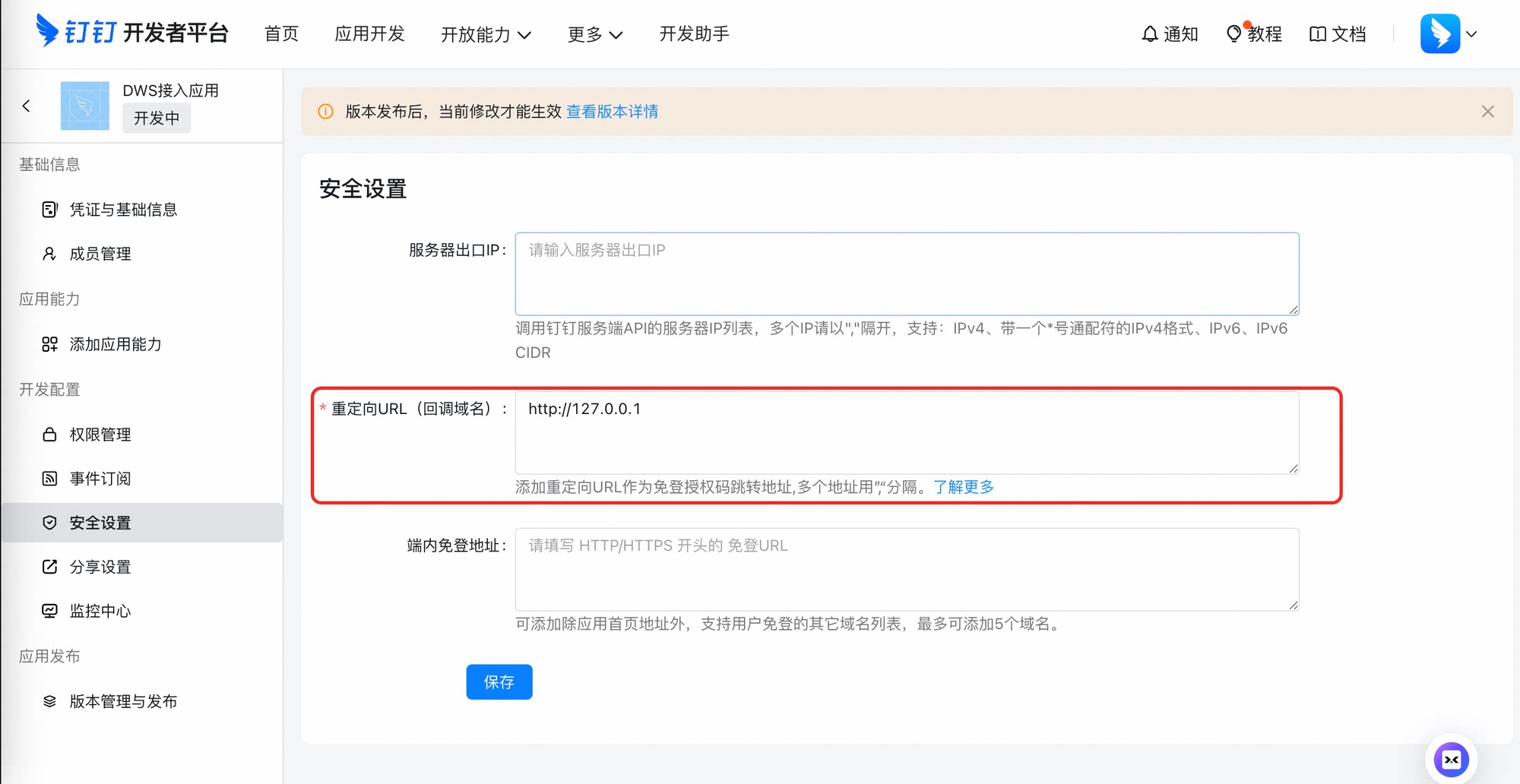
Go to app settings → Security Settings. Add the following redirect URLs and save:
http://127.0.0.1
https://login.dingtalk.com
http://127.0.0.1is for local browser login;https://login.dingtalk.comis for--devicedevice-flow login (Docker containers, remote servers, and other headless environments). We recommend configuring both.
View screenshot
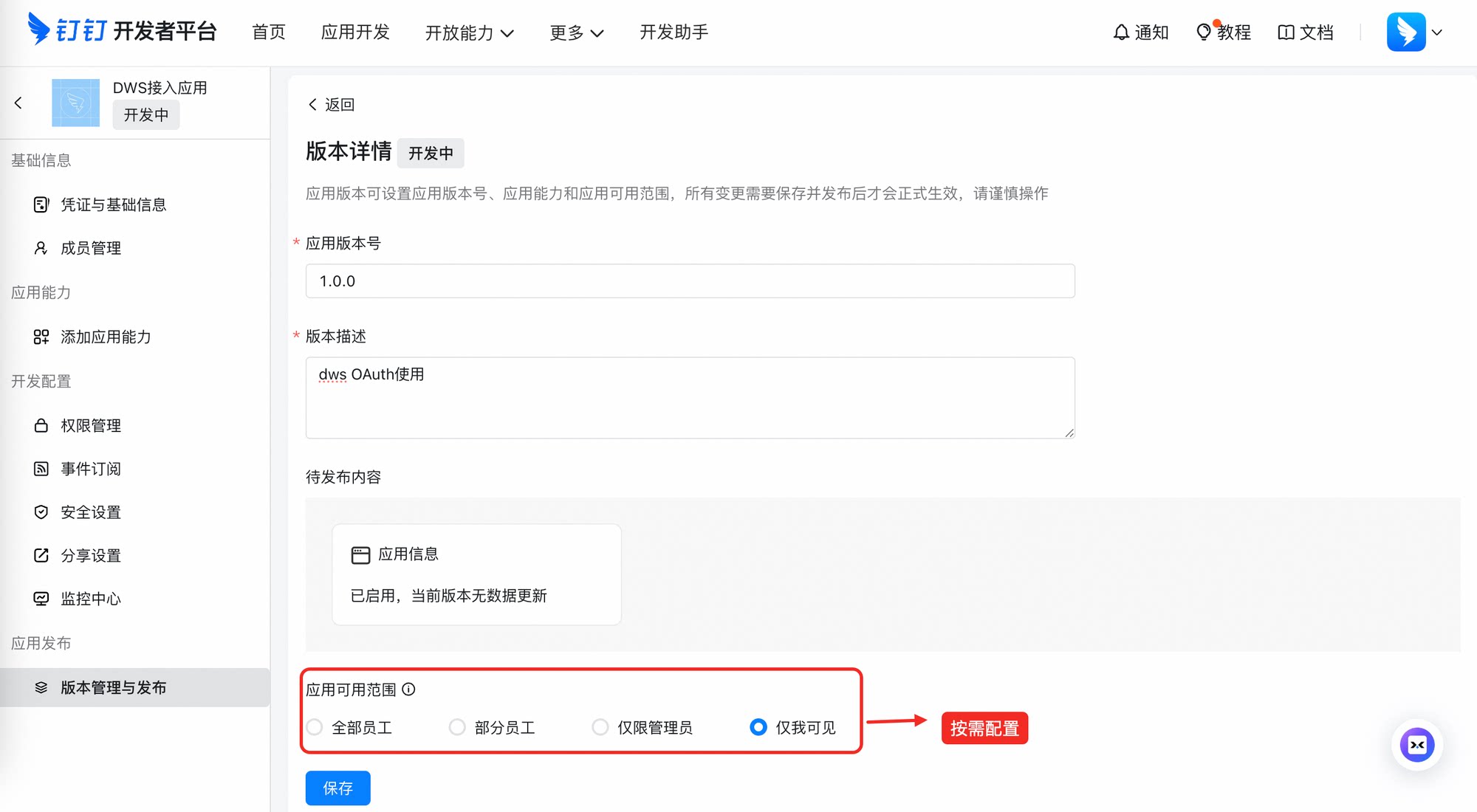
Click "App Release - Version Management & Release" to publish and go live.
View screenshot
Join the DingTalk DWS co-creation group and provide your Client ID and admin confirmation to complete whitelist setup.
dws auth login --client-id <your-app-key> --client-secret <your-app-secret>Or via environment variables:
export DWS_CLIENT_ID=<your-app-key>
export DWS_CLIENT_SECRET=<your-app-secret>
dws auth login
CLI flags take precedence over environment variables. Credentials are used for DingTalk's OAuth device flow.
dws contact user search --keyword "Alice"          # search contacts
dws calendar event list                            # list calendar events
dws todo task create --title "Quarterly report" --executors "<userId>"   # create a todo
dws todo task list --dry-run # preview without executingdws is designed as an AI-native CLI. Here's how to integrate it with your agent:
# Install dws
curl -fsSL https://raw.githubusercontent.com/DingTalk-Real-AI/dingtalk-workspace-cli/main/scripts/install.sh | sh

# Configure auth via environment variables (recommended for agents, no interactive login)
export DWS_CLIENT_ID=<your-app-key>
export DWS_CLIENT_SECRET=<your-app-secret>
dws auth login# Use --yes to skip confirmation prompts (required for agents)
dws todo task create --title "Review PR" --yes
# Use --dry-run to preview operations (safe execution)
dws contact user search --keyword "test" --dry-run
# Use --jq to extract precisely (save tokens)
dws contact user search --keyword "test" --jq '.response.content'
# Use --fields to return only needed fields
dws calendar event list --fields responseAgents don't need pre-built knowledge of every command. Use dws schema to dynamically discover capabilities:
# Step 1: Discover all available products
dws schema --jq '.products[] | {id, tool_count: (.tools | length)}'

# Step 2: Inspect target tool's parameter schema
dws schema aitable.query_records --jq '.tool.input_schema'

# Step 3: Construct the correct call
dws aitable record query --base-id "xxx" --table-id "yyy" --limit 10The smart correction engine is highly tolerant of common agent-generated mistakes:
| Agent Output | dws Auto-Corrects To |
|---|---|
--userId |
--user-id |
--limit100 |
--limit 100 |
--tabel-id |
--table-id |
--USER-ID |
--user-id |
--user_name |
--user-name |
After installing Agent Skills, tools like Claude Code / Cursor can use DingTalk capabilities directly:
# Install skills into current project
curl -fsSL https://raw.githubusercontent.com/DingTalk-Real-AI/dingtalk-workspace-cli/main/scripts/install-skills.sh | sh
See the AI Agent Skills section for details.
dws includes a built-in pipeline engine that auto-corrects common AI model parameter mistakes:
# Naming convention auto-conversion (camelCase / snake_case / UPPER -> kebab-case)
dws aitable record query --baseId x --tableId y         # auto-corrected to --base-id --table-id

# Sticky argument splitting
dws contact user search --keyword "test" --timeout30     # auto-split to --timeout 30

# Fuzzy flag name matching
dws aitable record query --base-id x --tabel-id y       # --tabel-id -> --table-id

# Value normalization (boolean / number / date / enum)
# "yes" -> true, "1,000" -> 1000, "2024/03/29" -> "2024-03-29", "ACTIVE" -> "active"Fine-grained output control to reduce token consumption:
# Return only specific fields
dws aitable record query --base-id x --table-id y --fields invocation,response

# Built-in jq expressions
dws aitable record query --base-id x --table-id y --jq '.invocation.params'
dws schema --jq '.products[] | {id, tools: (.tools | length)}'Agents can query parameter schemas before making calls:
dws schema                                              # list all products and tools
dws schema aitable.query_records                        # view parameter schema
dws schema aitable.query_records --jq '.tool.input_schema.required'   # view required fields
dws schema --jq '.products[].id' # extract all product IDs| Service | Command | Description |
|---|---|---|
| Contact | contact |
Users / departments |
| Chat | chat |
Group management / members / bot messaging / webhook |
| Calendar | calendar |
Events / meeting rooms / free-busy |
| Todo | todo |
Task management |
| Approval | approval |
Processes / forms / instances |
| Attendance | attendance |
Clock-in / shifts / statistics |
| Ding | ding |
DING messages / send / recall |
| Report | report |
Reports / templates / statistics |
| AITable | aitable |
AI table operations |
| Workbench | workbench |
App query |
| DevDoc | devdoc |
Open platform docs search |
Run dws --help for the full list, or dws <service> --help for subcommands.
Coming soon
doc (documents) · mail (email) · minutes (AI transcription) · drive (cloud drive) · conference (video) · tb (Teambition) · aiapp (AI apps) · live (streaming) · skill (marketplace)
dws treats security as a first-class architectural concern, not an afterthought. Credentials never touch disk, tokens never leave trusted domains, permissions never exceed grants, operations never escape audit — every API call must pass through DingTalk Open Platform's authentication and audit chain, no exceptions.
For Developers
| Mechanism | Details |
|---|---|
| Encrypted token storage | PBKDF2 + AES-256-GCM encryption, keyed by device physical MAC address; cross-platform Keychain/DPAPI integration provides additional protection — tokens cannot be decrypted on another machine |
| Input security | Path traversal protection (symlink resolution + working directory containment), CRLF injection blocking, Unicode visual spoofing filtering — prevents AI Agents from being tricked by malicious instructions |
| Domain allowlist | DWS_TRUSTED_DOMAINS defaults to *.dingtalk.com; bearer tokens are never sent to non-allowlisted domains |
| HTTPS enforced | All requests require TLS; HTTP only permitted for loopback during development |
| Dry-run preview | --dry-run shows call parameters without executing, preventing accidental mutations |
| Zero credential persistence | Client ID / Secret used in memory only — never written to config files or logs |
For Enterprise Admins
| Mechanism | Details |
|---|---|
| OAuth device-flow auth | Users must authenticate through an admin-authorized DingTalk application |
| Least-privilege scoping | CLI can only invoke APIs granted to the application — no privilege escalation |
| Allowlist gating | Admin confirmation required during co-creation phase; self-service approval planned |
| Full-chain audit | Every data read/write passes through the DingTalk Open Platform API — enterprise admins can trace complete call logs in real time; no anomalous operation can hide |
For ISVs
| Mechanism | Details |
|---|---|
| Tenant data isolation | Operates under authorized app identity; cross-tenant access is impossible |
| Skill sandbox | Agent Skills are Markdown documents (SKILL.md) — prompt descriptions only, no arbitrary code execution |
| Zero blind spots | Every API call during ISV–dws skill orchestration is forced through DingTalk Open Platform authentication — full call chain is traceable with no bypass path |
Found a vulnerability? Report via GitHub Security Advisories. See SECURITY.md.
The repo ships Agent Skills (SKILL.md files) for every DingTalk product. The install script deploys them to ~/.agents/skills/dws automatically.
# Install skills into the current project only
curl -fsSL https://raw.githubusercontent.com/DingTalk-Real-AI/dingtalk-workspace-cli/main/scripts/install-skills.sh | sh
install.shinstalls to$HOME/.agents/skills/dws(global);install-skills.shinstalls to./.agents/skills/dws(current project).
Author your own Agent Skills and orchestrate them with dws skills for cross-product workflows: ISV Skill → dws Skill → DingTalk Open Platform API (enforced auth + full audit).
Example: A CRM Skill invokes the Calendar Skill to create a client meeting, then triggers the Todo Skill to assign follow-ups — the AI agent completes cross-system collaboration in a single conversation.
- Reference — environment variables, exit codes, output formats, shell completion
- Architecture — discovery-driven pipeline, IR, transport layer
- Changelog — release history and migration notes
See CONTRIBUTING.md for build instructions, testing, and development workflow.
Apache-2.0