[SPARK-28901][SQL] SparkThriftServer's Cancel SQL Operation show it in JDBC Tab UI #25611
Conversation


|
gentl ping @juliuszsompolski @wangyum @srowen |
 AngersZhuuuu
changed the title
AngersZhuuuu
changed the title
 juliuszsompolski
left a comment
juliuszsompolski
left a comment
juliuszsompolski
left a comment
There was a problem hiding this comment.
I was looking into it at some time in the past but never finished. Some comments about the various race conditions between the cancellation and the query thread that I considered.
...e-thriftserver/src/main/scala/org/apache/spark/sql/hive/thriftserver/HiveThriftServer2.scala
Outdated
Show resolved
Hide resolved
...r/src/main/scala/org/apache/spark/sql/hive/thriftserver/SparkExecuteStatementOperation.scala
Outdated
Show resolved
Hide resolved
...r/src/main/scala/org/apache/spark/sql/hive/thriftserver/SparkExecuteStatementOperation.scala
Outdated
Show resolved
Hide resolved
| synchronized { | ||
| executionList(id).finishTimestamp = System.currentTimeMillis | ||
| executionList(id).state = ExecutionState.CANCELED | ||
| totalRunning -= 1 |
There was a problem hiding this comment.
It can happen that cancel() will race with query finishing, and then both onStatementCanceled() and onStatementFinish() will do totalRunning -= 1, resulting in negative count.
Instead of keeping a counter, for sessions and queries, it is better to do something like:
    def getOnlineSessionNum: Int = synchronized {
      sessionList.count(_._2.finishTimestamp == 0)
    }

    def isExecutionActive(execInfo: ExecutionInfo): Boolean = {
      !(execInfo.state == ExecutionState.FAILED ||
        execInfo.state == ExecutionState.CANCELED ||
        execInfo.closeTimestamp != 0)
    }

    /**
     * When an error or a cancellation occurs, we set the finishTimestamp of the statement.
     * Therefore, when we count the number of running statements, we need to exclude errors and
     * cancellations and count all statements that have not been closed so far.
     */
    def getTotalRunning: Int = synchronized {
      executionList.count {
        case (_, v) => isExecutionActive(v)
      }
    }
(Note that we should also consider statements that are CLOSED instead of FINISHED as not running anymore, because a FINISHED statement is still fetching results.)
(Same for sessions counters - though quite an obscure, there can be a race between a session timeout and a client closing session)
There was a problem hiding this comment.
@juliuszsompolski if we call close() before FINISH, onOperationClose() won't do
totalRunning -= 1, also a bug.
There was a problem hiding this comment.
@juliuszsompolski Can help to look at logic again
There was a problem hiding this comment.
@AngersZhuuuu I think it's easy to get something wrong with the totalRunning counter. Even if we covered all the cases now, it's hard to reason about all the possible paths, and easy to break. I would suggest to count it on the fly based on status, like I proposed before.
    def getOnlineSessionNum: Int = synchronized {
      sessionList.count(_._2.finishTimestamp == 0)
    }

    def isExecutionActive(execInfo: ExecutionInfo): Boolean = {
      !(execInfo.state == ExecutionState.FAILED ||
        execInfo.state == ExecutionState.CANCELED ||
        execInfo.closeTimestamp != 0)
    }

    /**
     * When an error or a cancellation occurs, we set the finishTimestamp of the statement.
     * Therefore, when we count the number of running statements, we need to exclude errors and
     * cancellations and count all statements that have not been closed so far.
     */
    def getTotalRunning: Int = synchronized {
      executionList.count {
        case (_, v) => isExecutionActive(v)
      }
    }
There was a problem hiding this comment.
def isExecutionActive(execInfo: ExecutionInfo): Boolean = {
!(execInfo.state == ExecutionState.FAILED ||
execInfo.state == ExecutionState.CANCELED ||
execInfo.state == ExecutionState.CLOSED)
}
make isExecutionActive() like this? to keep same code style
There was a problem hiding this comment.
It can cover all situation, very good ideal
...r/src/main/scala/org/apache/spark/sql/hive/thriftserver/SparkExecuteStatementOperation.scala
Outdated
Show resolved
Hide resolved
|
@juliuszsompolski There are some conflicts in the process. Changed a lot to cover all problems you have mentioned, include call |
...r/src/main/scala/org/apache/spark/sql/hive/thriftserver/SparkExecuteStatementOperation.scala
Outdated
Show resolved
Hide resolved
...r/src/main/scala/org/apache/spark/sql/hive/thriftserver/SparkExecuteStatementOperation.scala
Outdated
Show resolved
Hide resolved
...r/src/main/scala/org/apache/spark/sql/hive/thriftserver/SparkExecuteStatementOperation.scala
Outdated
Show resolved
Hide resolved
| setState(OperationState.PENDING) | ||
| setHasResultSet(true) // avoid no resultset for async run | ||
| statementId = UUID.randomUUID().toString | ||
| HiveThriftServer2.listener.onStatementPrepared( |
There was a problem hiding this comment.
I think it's enough to move onStatementStarted here, without adding Prepared as a separate state... I don't think there's much value added in distinguishing this from when the query starts running in the thread (it will go into a new state almost immediately after that)...
To not have to modify all these other operations, I would just stick with STARTED.
There was a problem hiding this comment.
remove it. A little forgot why I do this, move onStatementStarted here is enough
...e-thriftserver/src/main/scala/org/apache/spark/sql/hive/thriftserver/HiveThriftServer2.scala
Outdated
Show resolved
Hide resolved

| executionList(id).state = ExecutionState.CLOSED | ||
| if (lastState == ExecutionState.STARTED || lastState == ExecutionState.COMPILED) { | ||
| totalRunning -= 1 | ||
| } |

There was a problem hiding this comment.
does FINISHED need to be handled somewhere?
There was a problem hiding this comment.
does FINISHED need to be handled somewhere?
this place is to handle situation like : we have call close before finish, then the totalRunning value should -1 too. If we call cancel() or it finished, then when we call closeOperation, we won't do totalRunning -= 1. Since for FINISHED, has do totalRunning -= 1 , so here don't need to contain FINISHED

|
ok to test |
juliuszsompolski
left a comment
juliuszsompolski
left a comment
There was a problem hiding this comment.
Some more things that are not around a diffed line to anchor a comment to:
close()doessqlContext.sparkContext.clearJobGroup(), but that's incorrect because this is called from a different thread thanexecutewhich sets the JobGroup. Could you move it to afinallyinexecute?- In
runInternalin the catch block in https://github.com/apache/spark/pull/25611/files#diff-72dcd8f81a51c8a815159fdf0332acdcR212 when it fails to launch the background thread, you should callHiveThriftServer2.listener.onStatementErrorto notify of the error in that case as well. - nit: We log query submission etc. with logInfo. I think for consistency we could change the log in close to logInfo as well.
| // HiveServer will silently swallow them. | ||
| case e: Throwable => | ||
| val currentState = getStatus().getState() | ||
| if (currentState.isTerminal) { |
There was a problem hiding this comment.
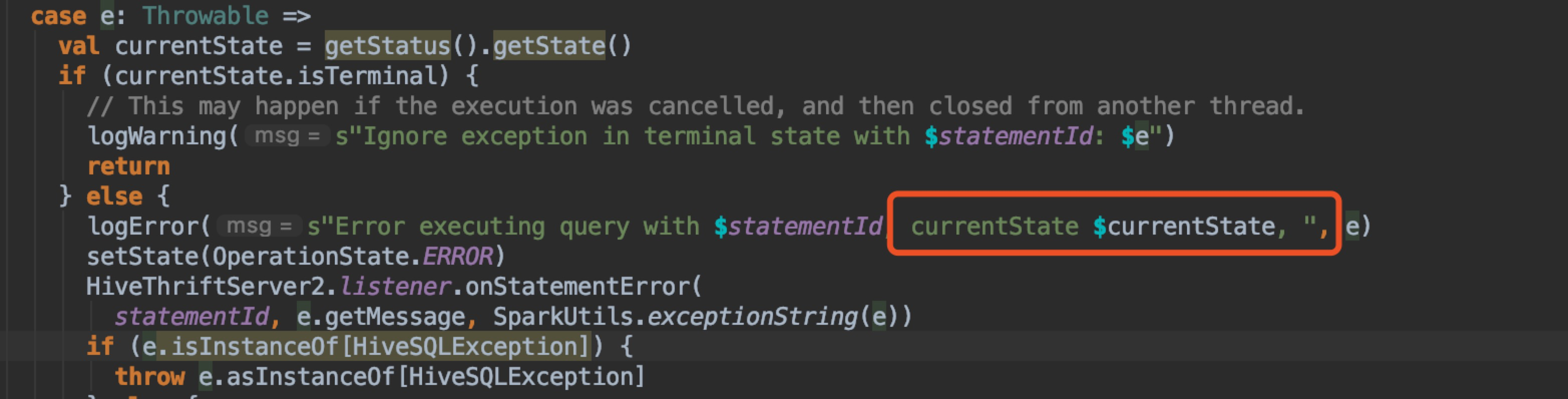
ocd nit: if (getStatus.getState.isTerminal) would make it consistent with other places in the file, and adding the val currentState now is not needed, as it's accessed only once anyway.
There was a problem hiding this comment.
ocd nit:
if (getStatus.getState.isTerminal)would make it consistent with other places in the file, and adding theval currentStatenow is not needed, as it's accessed only once anyway.
We should show currentState in
| sqlContext.sparkContext.setJobGroup(statementId, statement) | ||
| try { | ||
| logInfo(s"Running query '$statement' with $statementId") | ||
| setState(OperationState.RUNNING) |
There was a problem hiding this comment.
I'd change that to
synchronized {
  if (getStatus.getState.isTerminal) {
    logInfo(s"Query with $statementId in terminal state before it started running")
    return
  } else {
    logInfo(s"Running query with $statementId")
    setState(OperationState.RUNNING)
  }
}
instead of the if in runInternal. Otherwise, it can still change the state to cancelled between there and here.
(note: removed $statement from the log message; let's log it during submission)
| setState(OperationState.PENDING) | ||
| setHasResultSet(true) // avoid no resultset for async run | ||
| statementId = UUID.randomUUID().toString | ||
| HiveThriftServer2.listener.onStatementStart( |
There was a problem hiding this comment.
Could you add logInfo(s"Submitting query '$statement' with $statementId") here?
There was a problem hiding this comment.
Could you add
logInfo(s"Submitting query '$statement' with $statementId")here?
done
There was a problem hiding this comment.
ocd formatting nit: move setHasResultSet(true) below statementid, logInfo and onStatementStart, to do all the initialization bookkeeping first.
| cleanup(OperationState.CANCELED) | ||
| synchronized { | ||
| if (!getStatus.getState.isTerminal) { | ||
| logInfo(s"Cancel '$statement' with $statementId") |
There was a problem hiding this comment.
Could you do logInfo(s"Cancel query with $statementId")? I think it's enough to log the full statement at submission time.
| if (!getStatus.getState.isTerminal) { | ||
| setState(OperationState.FINISHED) | ||
| HiveThriftServer2.listener.onStatementFinish(statementId) | ||
| } |
There was a problem hiding this comment.
nit: I think this could become a finally { synchronized { block; the if check will make sure that it doesn't go to finished after another state.
There was a problem hiding this comment.
nit: I think this could become a
finally { synchronized {block; the if check will make sure that it doesn't go to finished after another state.
Reasonable, I add too much control.
| logWarning(s"Ignore exception in terminal state with $statementId: $e") | ||
| return | ||
| } else { | ||
| logError(s"Error executing query, currentState $currentState, ", e) |
There was a problem hiding this comment.
nit: Error executing query with $statementId
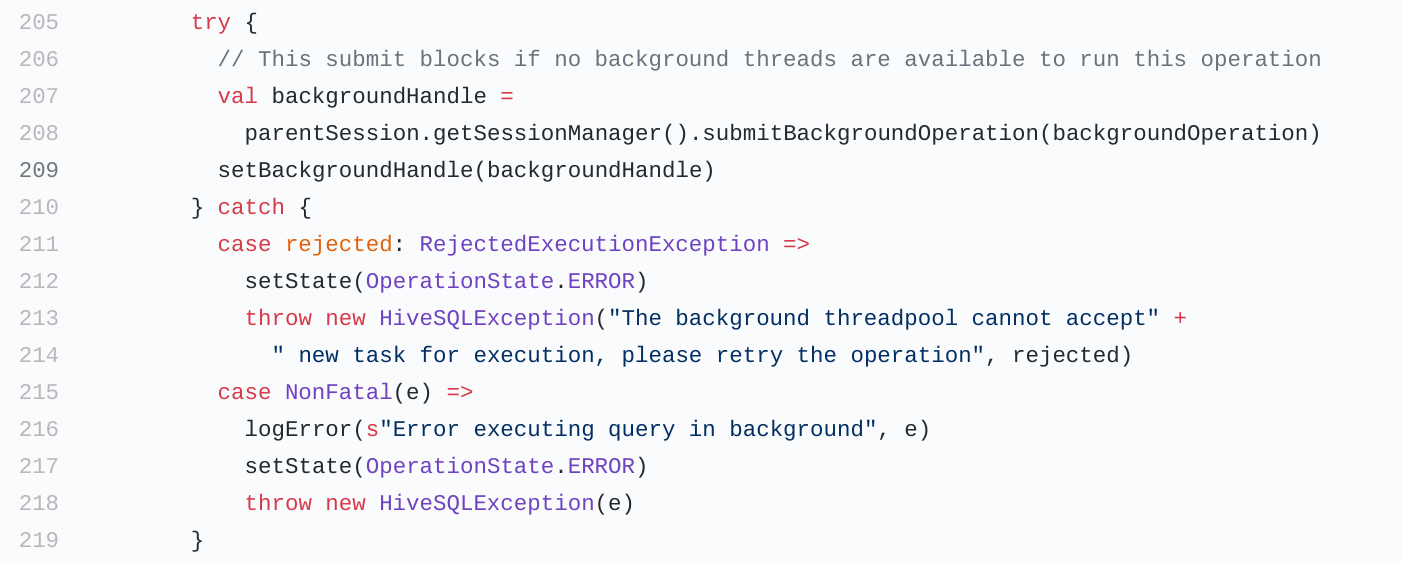
New case, should do this. |

juliuszsompolski
left a comment
juliuszsompolski
left a comment
There was a problem hiding this comment.
LGTM with ocd formatting nits
| (sqlContext: SQLContext, sessionToActivePool: JMap[SessionHandle, String]) | ||
| extends ExecuteStatementOperation(parentSession, statement, confOverlay, runInBackground) | ||
| with Logging { | ||
| with Logging { |
There was a problem hiding this comment.
nit: revert. https://github.com/databricks/scala-style-guide#spacing-and-indentation with shouldn't get extra indentation compared to extends
There was a problem hiding this comment.
my local scala style may have some problem, not fit with that.
| def onStatementError( | ||
| id: String, | ||
| errorMessage: String, | ||
| errorTrace: String): Unit = synchronized { |
There was a problem hiding this comment.
ocd nit: changing errorMessage to errorMsg would make it fit on one line.
| Thread.currentThread().setContextClassLoader(executionHiveClassLoader) | ||
|
|
||
| sqlContext.sparkContext.setJobGroup(statementId, statement) | ||
|
|
There was a problem hiding this comment.
ocd nit: empty lines would be more readable if it was
...
      }

      // Always use the latest class loader provided by executionHive's state.
      val executionHiveClassLoader = sqlContext.sharedState.jarClassLoader
      Thread.currentThread().setContextClassLoader(executionHiveClassLoader)

      sqlContext.sparkContext.setJobGroup(statementId, statement)
      result = sqlContext.sql(statement)
...
- it then separates the initialization part, the hive class loader part and the Spark part with empty lines.
There was a problem hiding this comment.
Consider a lot , learn it.
| setBackgroundHandle(backgroundHandle) | ||
| } catch { | ||
| case rejected: RejectedExecutionException => | ||
| logError("Error submit query in background, query rejected", rejected) |
There was a problem hiding this comment.
nit: "Error submit" -> "Error submitting"
| if (currentState.isTerminal) { | ||
| // This may happen if the execution was cancelled, and then closed from another thread. | ||
| logWarning(s"Ignore exception in terminal state with $statementId: $e") | ||
| return |
There was a problem hiding this comment.
nit: you either don't need the else or the return
I would keep the return and get rid of the else to save on indentation.
| } finally { | ||
| synchronized { | ||
| setState(OperationState.FINISHED) | ||
| HiveThriftServer2.listener.onStatementFinish(statementId) |
There was a problem hiding this comment.
Missed it: You still need to wrap it in if (!currentState.isTerminal) { otherwise it will get executed in finally after e.g. an ERROR, or you can have a race condition with cancel/close.
When I wrote to put it in the finally block, I meant that then it could be together with clearJobGroup, but the if is still needed.
There was a problem hiding this comment.
add if here is the most direct way, otherwise add too much control
| // RDDs will be cleaned automatically upon garbage collection. | ||
| logDebug(s"CLOSING $statementId") | ||
| cleanup(OperationState.CLOSED) | ||
| sqlContext.sparkContext.clearJobGroup() |
There was a problem hiding this comment.
Nit: make that logDebug logInfo(s"Closed statement with $statementId"), to make it consistent with other logs.
There was a problem hiding this comment.
Nit: make that logDebug
logInfo(s"Closed statement with $statementId"), to make it consistent with other logs.
maybe logInfo(s"Close statement with $statementId") ?
There was a problem hiding this comment.
I'm fine with both Close and Closed. I see that you already committed Closed.
juliuszsompolski
left a comment
juliuszsompolski
left a comment
There was a problem hiding this comment.
LGTM. Thank you @AngersZhuuuu for bearing with all my comments! :-)
| trimExecutionIfNecessary() | ||
| } | ||
|
|
||
|
|
There was a problem hiding this comment.
promise final nit: remove double empty line
| // RDDs will be cleaned automatically upon garbage collection. | ||
| logDebug(s"CLOSING $statementId") | ||
| cleanup(OperationState.CLOSED) | ||
| sqlContext.sparkContext.clearJobGroup() |
There was a problem hiding this comment.
I'm fine with both Close and Closed. I see that you already committed Closed.
|
@juliuszsompolski Thanks a lot for your review, this is the most deeply code review I have had, learn a lot from it. , |

|
Thanks! Merged to master. |

| return | ||
| // Actually do need to catch Throwable as some failures don't inherit from Exception and | ||
| // HiveServer will silently swallow them. | ||
| case e: Throwable => |
There was a problem hiding this comment.
@AngersZhuuuu
I think I found one more problem:
If cancel() and close() is called very quickly after the query is started, then they may both call cleanup() before Spark Jobs are started. Then sqlContext.sparkContext.cancelJobGroup(statementId) does nothing.
But then the execute thread can start the jobs, and only then get interrupted and exit through here. But then it will exit here, and no-one will cancel these jobs and they will keep running even though this execution has exited.
I think it can be fixed by:
      case e: Throwable =>
        // In any case, cancel any remaining running jobs.
        // E.g. a cancel() operation could have called cleanup() which canceled the Jobs before
        // they started.
        if (statementId != null) {
          sqlContext.sparkContext.cancelJobGroup(statementId)
        }
There was a problem hiding this comment.
Got you point.
When cleanup().
SparkContext haven't setup jobGroup.
But execute thread start execute and setup jobGroup.
cleanup() can cancel background thread task but can't promise cancelJobGroup since it may be called before sparkContext setupJobGroup
But cancelJobGroup here seem can't stop execute() method run.

| // Always use the latest class loader provided by executionHive's state. | ||
| val executionHiveClassLoader = sqlContext.sharedState.jarClassLoader | ||
| Thread.currentThread().setContextClassLoader(executionHiveClassLoader) | ||
|
|
There was a problem hiding this comment.
@juliuszsompolski call cancel here for run statement in sync mode. seems can't stop task running .
| val executionHiveClassLoader = sqlContext.sharedState.jarClassLoader | ||
| Thread.currentThread().setContextClassLoader(executionHiveClassLoader) | ||
|
|
||
| sqlContext.sparkContext.setJobGroup(statementId, statement) |
There was a problem hiding this comment.
How about move judgement to this place . I think setState(RUNNING) after setJobGroup is ok.
Since we can think setClassLoader and setJobGroup is prepare work for running
sqlContext.sparkContext.setJobGroup(statementId, statement)
  synchronized {
        if (getStatus.getState.isTerminal) {
          logInfo(s"Query with $statementId in terminal state before it started running")
          return
        } else {
          logInfo(s"Running query with $statementId")
          setState(OperationState.RUNNING)
        }
      }
There was a problem hiding this comment.
@AngersZhuuuu
I don't think it will help. It's not just about setJobGroup, but about actually starting the job. You can setJobGroup, then cancelJobGroup, and then start running Jobs in that Job Group.
What cancelJobGroup does is only cancel Jobs that are currently running in the Job group, it doesn't prevent further jobs being started. So I think it can still go past here, and then be cancelled before it actually starts the Jobs.
I think it would be safer to handle it from the catch block.
There was a problem hiding this comment.
But when
You can setJobGroup, then cancelJobGroup, and then start running Jobs in that Job Group.
The job is under no JobGroup since when call cancelJobGroup, jobGroup in localProperties has been cleared
There was a problem hiding this comment.
Let's have
- Thread1 be in
execute()after this synchronized block, but before the Jobs have started - Thread2 be a user connection calling
cancel(). It cancels all jobs in the job group, and notifies Thread1 - But before Thread1 gets the notification and throws InterruptedException, it starts some Jobs.
- Then Thread1 gets InterruptedException, and exits through the catch and finally block. It does a clearJobGroup in the finally, but that doesn't cancel the Jobs started in 3. These Jobs keep running after Thread1 exits, and nobody cancels them.
I think that the only way to prevent this, is to call another cancelJobGroup from the catch block when an exception comes.
There was a problem hiding this comment.
Get your point.
Cancel before setJobGroup, but there will be an interval between cancel and execute thread been interrupted. Then job won't be canceled after execute thread get into catch block.

…d interrupted

### What changes were proposed in this pull request?
Discuss in #25611

If cancel() and close() is called very quickly after the query is started, then they may both call cleanup() before Spark Jobs are started. Then sqlContext.sparkContext.cancelJobGroup(statementId) does nothing.
But then the execute thread can start the jobs, and only then get interrupted and exit through here. But then it will exit here, and no-one will cancel these jobs and they will keep running even though this execution has exited.

So  when execute() was interrupted by `cancel()`, when get into catch block, we should call canJobGroup again to make sure the job was canceled.

### Why are the changes needed?

### Does this PR introduce any user-facing change?
NO

### How was this patch tested?
MT

Closes #25743 from AngersZhuuuu/SPARK-29036.

Authored-by: angerszhu <[email protected]>
Signed-off-by: Yuming Wang <[email protected]>
6 participants


What changes were proposed in this pull request?
Current Spark Thirft Server can't support cancel SQL job, when we use Hue to query throgh Spark Thrift Server, when we run a sql and then click cancel button to cancel this sql, we will it won't work in backend and in the spark JDBC UI tab, we can see the SQL's status is always COMPILED, then the duration of SQL is always increasing, this may make people confused.
Why are the changes needed?
If sql status can't reflect sql's true status, it will make user confused.
Does this PR introduce any user-facing change?
SparkthriftServer's UI tab will show SQL's status in CANCELED when we cancel a SQL .
How was this patch tested?
Manuel tested
UI TAB Status

backend log
