Add encryption key derivation from PIN #10
Conversation


 sosthene-nitrokey
force-pushed
the
ext-encryption
branch
2 times, most recently
from
sosthene-nitrokey
force-pushed
the
ext-encryption
branch
2 times, most recently
from
73ba8cc to
59980c5
Compare

|
When creating a SoftwareAuth instance, the runner can give it some key material that would come from the hardware itself. This makes it slightly harder to extract data required for any brute-forcing. Here is a pseudocode overview of the key derivation process. // length depends on hardware
let device_ikm: [u8]= values_from_hardware();
// generated on first power-up, stays constant for the lifetime of the device
let device_salt: [u8;32] = csprng();
// The salt is useful for the security proof of HKDF
let device_prk = hkdf_extract(salt: device_salt, ikm: device_ikm);
// There is domain separation between each app
for app_id in apps {
let app_encryption_key: [u8; 32] = hkdf_expand(device_prk, info: app_id, 32);
// Deriving keys from a PIN or Password provided by the user
for pwd in passwords {
let salt = csprng();
// Per-pin key is fully random, then wrapped using the Pin
let wrapped_key = csprng();
// This is fine because app_encryption_key is uniform, therefore pin_key is too
//
// We can't use PBKDF or argon2 here because of limited hardware.
// Ideally such a step would be done on the host
//
// `pin_key` is never stored, and derived on each call to `CheckPin` and `GetPinKey`
let pin_key = HMAC(key: app_encryption_key, pin_id || len(pwd) || pwd || salt);
// On pin creation or change, the key is wrapped and stored on a persistent filesystem
// The constant nonce is acceptable and won't lead to nonce reuse because the `pin_key` is only used to encrypt data once
// Any change of pin changes the `pin_key` also changes the salt
// which means that it is not possible to use the same key twice
store(aead_encrypt(key: pin_key, data: wrapped_key, nonce: [0;12]))
// On GetPinKey requests, this gets us the key
aead_decrypt(key: pin_key, data: load(), nonce: [0;12]))
}
} |

|
Please add a patch for littlefs2 to fix the CI. https://github.com/Nitrokey/littlefs2/releases/tag/v0.3.2-nitrokey-2 should work. |
|
This patch prevents trussed from compiling because of the |
|
It appears to work by using your littlefs 0.4 branch. |
Cargo.toml
Outdated
| trussed = { version = "0.1.0", features = ["serde-extensions", "virt"] } | ||
|
|
||
| [patch.crates-io] | ||
| trussed = { git = "https://github.com/robin-nitrokey/trussed.git", rev = "f943d88aa43c72bc76c5c8bf8c8b5bb3638a4b85" } |
There was a problem hiding this comment.
Use https://github.com/Nitrokey/trussed/releases/tag/v0.1.0-nitrokey-5 instead for easier readability and for reproducibility?
There was a problem hiding this comment.
Actually the branch we were currently using was missing trussed-dev/trussed#94 so I fixed it. I thought it was the other way around
sosthene-nitrokey
force-pushed
the
ext-encryption
branch
from
12de3ce to
709150d
Compare
|
After a bit of discussion with @szszszsz here is a clearer version of the pseudocode: // length depends on hardware
let device_ikm: [u8]= values_from_hardware();
// generated on first power-up, stays constant for the lifetime of the device
let device_salt: [u8;32] = csprng();
// The salt is useful for the security proof of HKDF
let device_prk = hkdf_extract(salt: device_salt, ikm: device_ikm);
fn get_app_key(app_id) {
// Domain separation between the apps
// This means the `app_key` can also be used for purposes other than Pin key derivation.
return hkdf_expand(prk: device_prk, info: app_id, output_len: 32);
}
fn register_pin(app_id, pin_id, pin) {
let app_key = get_app_key(app_id);
let salt = csprng();
let key_to_be_wrapped = csprng();
// Get a pseudo-random key from the pin and the salt
//
// This is fine because app_key is uniform, therefore pin_key is too
// because HMAC is a PRF
//
// We can't use PBKDF or argon2 here because of limited hardware.
// Ideally such a step would be done on the host
//
// `pin_kek` is never stored
let pin_kek = HMAC(key: app_key, pin_id || len(pin) || pin || salt);
// On pin creation or change, the key is wrapped and stored on a persistent filesystem
// The constant nonce is acceptable and won't lead to nonce reuse because the `pin_kek` is only used to encrypt this data once
//
// Any change of pin changes also changes the salt
// which means that it is not possible to get the `pin_kek` twice
let wrapped_key = aead_encrypt(key: pin_kek, data: key_to_be_wrapped, nonce: [0;12]);
to_presistent_storage(salt, wrapped_key);
}
fn get_pin_key(app_id, pin_id, pin) {
let app_key = get_app_key(app_id);
let (salt, wrapped_key) = from_persistent_storage();
// re-derive the pin kek
let pin_kek = HMAC(key: app_key, pin_id || len(pin) || pin || salt);
// Unwrap the key
let unwrapped_key = aead_decrypt(key: pin_kek, data: wrapped_key , nonce: [0;12])
return unwrapped_key;
}
fn change_pin(app_id, pin_id, old_pin, new_pin) {
let app_key = get_app_key(app_id);
let key_to_be_wrapped = get_pin_key(app_id, pin_id, pin);
// The procedure is the same as for `register_pin` but it reuses the `key_to_be_wrapped` instead of generating it
// Generate a new salt for the new pin
let salt = csprng();
let pin_kek = HMAC(key: app_key, pin_id || len(new_pin) || new_pin || salt);
let wrapped_key = aead_encrypt(key: pin_kek, data: key_to_be_wrapped, nonce: [0;12]);
to_presistent_storage(salt, wrapped_key);
}The algorithm used are SHA-256 (for HKDF and HMAC) and ChaCha8Poly1305 (for AEAD). The CSPRNG comes from Trussed, so it's a References: |
sosthene-nitrokey
force-pushed
the
ext-encryption
branch
from
cef1592 to
5962c75
Compare

|
The reference to ChaCha8Poly1305 seems to be wrong. Can you check that? |
|
Supporting diagram to the pseudocode: |
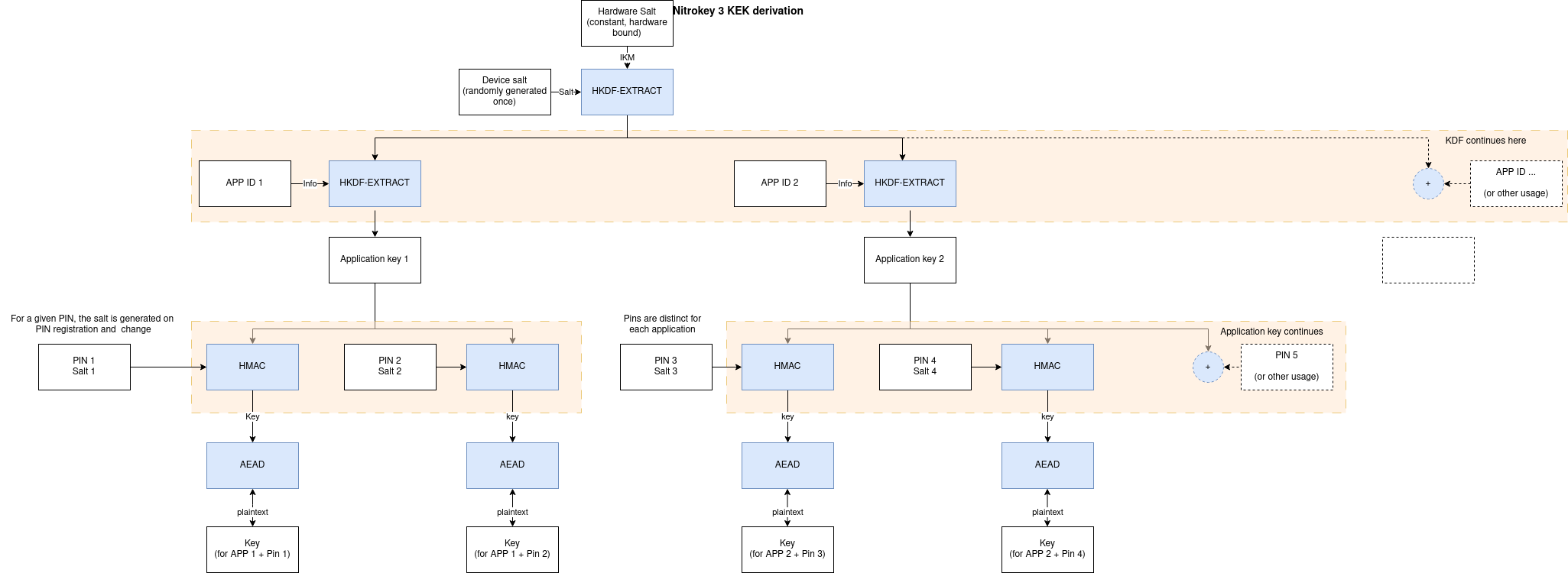
|
There isn't really a standard to point to for ChaCha8 so it points instead to a publication justifying reduced rounds. I also added the ChaCha20 RFC for completeness |
|
In other words, response to my request is at:
|
These are irrelevant as we don't use Poly1305 directly but instead use it as part of the ChaCha20Poly1305 AEAD construction, so the Poly1305 key is generated using ChaCha: https://datatracker.ietf.org/doc/html/rfc8439#section-2.6 using the key and the nonce, making it unpredictable. The relevant part applies to the nonce: https://datatracker.ietf.org/doc/html/rfc8439#section-2.8
In our case it is ok because the |
Here is the proper Chacha8 description: |
sosthene-nitrokey
force-pushed
the
ext-encryption
branch
4 times, most recently
from
f9dcd0c to
7b32e40
Compare
sosthene-nitrokey
force-pushed
the
ext-encryption
branch
from
7b32e40 to
29c3f37
Compare

 robin-nitrokey
left a comment
robin-nitrokey
left a comment
robin-nitrokey
left a comment
There was a problem hiding this comment.
Looks good to me, though I did not double-check the implementation details yet.
The only issue I see is that it is easy to make a mistake when choosing between the SetPin and ChangePin requests. Should we drop the SetPin request to avoid accidentally dropping the derived key? See also: Nitrokey/trussed-secrets-app#34 (comment)
|
I think we also talked about having a way to access the application key (or deriving a key from it) when no PIN is set. That’s not implemented yet, right? |
We could instead make it fail when the Pin type is not a simple hash to ensure such bugs are obvious in testing. I still think we want to have it available.
No that is not implemented. I think it can be a separate PR. Do we need it now? |
Sounds good. |
|
Another solution I see would be to separate |
 sosthene-nitrokey
force-pushed
the
ext-encryption
branch
from
sosthene-nitrokey
force-pushed
the
ext-encryption
branch
from
29c3f37 to
d2b08be
Compare
Would there be a difference between the two requests? Or just two names for the same request? |
|
|
Makes sense. Do you want to add it to this PR or should we do it separately? |
|
We can do it in another PR. |


4 participants


The test currently fail because of a bug incbor-smolfixed in https://github.com/nickray/cbor-smol/pullsThe tests now fails because of the littlefs2 lookahead bug fixed in version 0.4