metrics: add cluster_installer series #213
Conversation


 openshift-ci-robot
added
the
do-not-merge/work-in-progress
openshift-ci-robot
added
approved
openshift-ci-robot
added
the
do-not-merge/work-in-progress
openshift-ci-robot
added
approved
|
Needs openshift/telemeter#189 before we can see the results. |
|
/cc @smarterclayton |
openshift-ci-robot
added
size/XXL
 openshift-ci-robot
added
the
needs-rebase
openshift-ci-robot
added
the
needs-rebase

Back in 6c1716f, we dropped the direct dependency on glog, which
resulted in `dep ensure` showing the following warning:

    Warning: the following project(s) have [[constraint]] stanzas in
    Gopkg.toml:

      ✗  github.com/golang/glog

It also resulted in the constraint no longer being respected
(`[[override]]` is required for transitive dependencies). Since we have
been using a newer version of glog for almost two months now, I'm
dropping the constraint instead of converting into an override.
openshift-ci-robot
removed
the
needs-rebase
|
/test ci/prow/e2e-aws |
1 similar comment
|
/test ci/prow/e2e-aws |
|
/test e2e-aws |
|
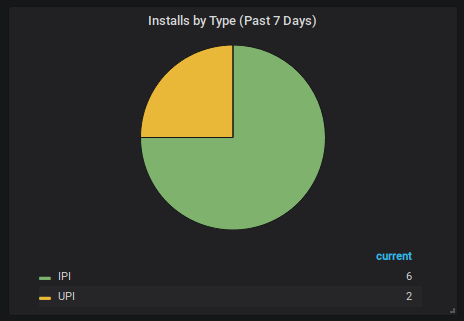
The metrics appear to be working:
/retitle metrics: add cluster_installer series |
 openshift-ci-robot
changed the title
openshift-ci-robot
removed
the
do-not-merge/work-in-progress
openshift-ci-robot
changed the title
openshift-ci-robot
removed
the
do-not-merge/work-in-progress

pkg/cvo/metrics.go
Outdated
| }, []string{"name", "condition"}), | ||
| clusterInstaller: prometheus.NewGaugeVec(prometheus.GaugeOpts{ | ||
| Name: "cluster_installer", | ||
| Help: "Reports the installation method for the cluster", |

There was a problem hiding this comment.
Is this supposed to have UPI vs IPI?
There was a problem hiding this comment.
I think you'd want to return 1 / 0 if this is about IPI vs UPI, or 1 always if you have a label for UPI. Recommend documenting your labels in this.
There was a problem hiding this comment.
Well, it's a bit more than that. You can derive UPI vs IPI from it, but you can also look at what invoked the installer (e.g. Hive). I can filled out that help text a bit more though.
There was a problem hiding this comment.
Wait, so now I'm confused. Is type=UPI the label? Expected to see a test with that as an example (just so we know).
Might want to update metrics.md too once you finalize.
There was a problem hiding this comment.
I've updated metrics.md. Can you let me know if it makes sense now?
This series reports what installed the cluster. In order to do this, the
openshift-install ConfigMap, which is written by the installer when
doing an IPI install, is read. This ConfigMap is only injected during an
IPI installation and contains the invoker (e.g. username, Hive) as well
as the openshift-install version. The absence of this ConfigMap implies
a UPI installation. This data will allow us to determine whether a
cluster was installed IPI or UPI and, once CI and Hive have been
updated, whether the cluster was created by CI or Hive.

Because the data in this series never changes, it should compress
nicely so we shouldn't have to worry about wasting space.

If the data in the ConfigMap is missing, those label values are reported
as `<missing>`. That was used instead of an empty value in order to
distinguish between normal operation and an anomalous state. If the
openshift-install ConfigMap exists, it will have all of those fields
specified unless something were to erroneously remove them.

|
/lgtm |

|
[APPROVALNOTIFIER] This PR is APPROVED This pull-request has been approved by: crawford, smarterclayton The full list of commands accepted by this bot can be found here. The pull request process is described here DetailsNeeds approval from an approver in each of these files:
Approvers can indicate their approval by writing |

|
/retest Please review the full test history for this PR and help us cut down flakes. |
|
/retest Please review the full test history for this PR and help us cut down flakes. |
17 similar comments
|
/retest Please review the full test history for this PR and help us cut down flakes. |
|
/retest Please review the full test history for this PR and help us cut down flakes. |
|
/retest Please review the full test history for this PR and help us cut down flakes. |
|
/retest Please review the full test history for this PR and help us cut down flakes. |
|
/retest Please review the full test history for this PR and help us cut down flakes. |
|
/retest Please review the full test history for this PR and help us cut down flakes. |
|
/retest Please review the full test history for this PR and help us cut down flakes. |
|
/retest Please review the full test history for this PR and help us cut down flakes. |
|
/retest Please review the full test history for this PR and help us cut down flakes. |
|
/retest Please review the full test history for this PR and help us cut down flakes. |
|
/retest Please review the full test history for this PR and help us cut down flakes. |
|
/retest Please review the full test history for this PR and help us cut down flakes. |
|
/retest Please review the full test history for this PR and help us cut down flakes. |
|
/retest Please review the full test history for this PR and help us cut down flakes. |
|
/retest Please review the full test history for this PR and help us cut down flakes. |
|
/retest Please review the full test history for this PR and help us cut down flakes. |
|
/retest Please review the full test history for this PR and help us cut down flakes. |
|
/retest |

|
@crawford: The following test failed, say
Full PR test history. Your PR dashboard. Please help us cut down on flakes by linking to an open issue when you hit one in your PR. DetailsInstructions for interacting with me using PR comments are available here. If you have questions or suggestions related to my behavior, please file an issue against the kubernetes/test-infra repository. I understand the commands that are listed here. |

|
Cross-linking openshift/installer#1890 and openshift/installer#2046 which are injecting this information into the cluster. |
|
/cherrypick release-4.1 |

|
@crawford: #213 failed to apply on top of branch "release-4.1": DetailsIn response to this:
Instructions for interacting with me using PR comments are available here. If you have questions or suggestions related to my behavior, please file an issue against the kubernetes/test-infra repository. |

7 participants


This series reports what installed the cluster. In order to do this, the
openshift-install ConfigMap, which is written by the installer when
doing an IPI install, is read. This ConfigMap is only injected during an
IPI installation and contains the invoker (e.g. username, Hive) as well
as the openshift-install version. The absence of this ConfigMap implies
a UPI installation.
Because the data in this series never changes, it should compress
nicely so we shouldn't have to worry about wasting space.